>
Gobiiformes (Gobies) >
Gobiidae (Gobies) > Gobionellinae
Etymology: Knipowitschia: Because of N.M.Knipowitsch, a zoologist and Russian ichthyologist from the Academy of Sciences. Expeditions in "Pomor" and "Pervosvanniy" ships to Azov and Black sea (1898-1908).
Eponymy: Nikolai Mikhailovich Knipovich (also given as Knipowitsch) (1862–1939) was a Russian oceanographer, marine zoologist and ichthyologist. [...] (Ref. 128868), visit book page.
More on author: Berg.
Taxonomic Remarks
Kavraiskii 1916 is a nomen nudum (M. Kottelat, pers. comm.)
Umwelt: Milieu / Klimazone / Tiefenbereich / Verbreitungsgebiet
Ökologie
seewasser; süßwasser; brackwasser demersal; amphidrom (Ref. 46888); tiefenbereich 0 - 2 m (Ref. 12215). Temperate; 47°N - 38°N, 12°E - 61°E
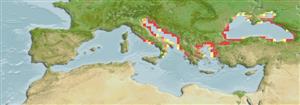
Eurasia: along the coasts of Black, Azov, Caspian and Aegean seas west to Aliakmon drainage (Greece). Identity of the population along the eastern shore of Adriatic is questionable. Introduced in the Aral Sea and is now extirpated.
Länge bei der ersten Reifung / Größe / Gewicht / Alter
Geschlechtsreife: Lm 2.2, range 2 - 2.3 cm
Max length : 5.0 cm TL Männchen/unbestimmt; (Ref. 4696); max. veröff. Alter: 2.00 Jahre (Ref. 126411)
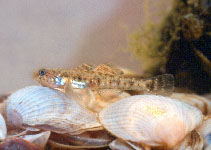
Rückenflossenstacheln (insgesamt) : 7; Rückenflossenweichstrahlen (insgesamt) : 7 - 8; Afterflossenstacheln: 1; Afterflossenweichstrahlen: 7 - 9; Wirbelzahl: 31 - 32. Anterior oculoscapular, preopercular, and sometimes posterior oculoscapular, canals present; body squamation complete on caudal peduncle and along at least lateral midline to axil. Males with 4-5 major vertical bars.
Body shape (shape guide): elongated.
Inhabit fresh to hyper-saline waters (to 55 ppt) of lakes, estuaries and lagoons, in shallow areas with much weed. Feed on small crustaceans and chironomid larvae (Ref.12215); larvae of the mussel Dreissena polymorpha (Ref. 59043). Lives less than 2 years. Spawns after first winter. Eggs are attached to the roof of a cavity under stones, plant material or shells and are defended by male. Postlarvae are pelagic. (Ref.59043).
Spawns up to 4 portions of eggs (Ref. 59043).
Miller, P.J., 1986. Gobiidae. p. 1019-1085. In P.J.P. Whitehead, M.-L. Bauchot, J.-C. Hureau, J. Nielsen and E. Tortonese (eds.) Fishes of the North-eastern Atlantic and the Mediterranean. Volume 3. UNESCO, Paris. (Ref. 4696)
IUCN Rote Liste Status (Ref. 130435: Version 2025-2 (Global))
Bedrohung für Menschen
Harmless
Nutzung durch Menschen
Tools
Zusatzinformationen
Download XML
Internet Quellen
Schätzungen auf der Grundlage von Modellen
Bevorzugte Temperatur (Ref.
123201): 14.4 - 18.7, mean 17.6 °C (based on 188 cells).
Phylogenetischer Diversitätsindex (Ref.
82804): PD
50 = 0.5000 [Uniqueness, from 0.5 = low to 2.0 = high].
Bayesian length-weight: a=0.00724 (0.00627 - 0.00837), b=3.06 (3.02 - 3.10), in cm total length, based on LWR estimates for this species (Ref.
93245).
Trophische Ebene (Ref.
69278): 3.3 ±0.45 se; based on food items.
Generation time: 0.7 ( na - na) years. Estimated as median ln(3)/K based on 1
growth studies.
Widerstandsfähigkeit (Ref.
120179): hoch, Verdopplung der Population dauert weniger als 15 Monate. (Preliminary K or Fecundity.).
Anfälligkeit der Fischerei (Ref.
59153): Low vulnerability (10 of 100).
🛈