Taxonomic Remarks
The species in the genera Spratelloides Bleeker, 1851 and Jenkinsia Jordan & Evermann, 1896 should most probably be assigned to a separated family from Clupeidae and Dussumieriidae (Lavoué, pers. comm., July 2013). See a preliminary analysis in Lavoué et al. (2013: Ref. 93878).
Environnement : milieu / zone climatique / profondeur / gamme de distribution
Écologie
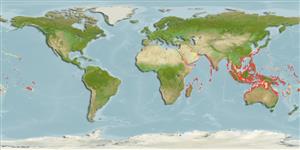
marin pelagic-neritic; profondeur ? - 40 m (Ref. 86942). Tropical; 33°N - 30°S, 33°E - 136°W (Ref. 188)
Indo-Pacific, from Red Sea south to Tanzania and east to Samoa (excluding the Cook, Society and Marquesas islands) and the Tuamoto Islands, north to southern Japan and south to western Australia and Kermadec Islands.
Longueur à la première maturité / Taille / Poids / Âge
Maturité: Lm ?, range 4 - ? cm
Max length : 10.5 cm SL mâle / non sexé; (Ref. 54980)
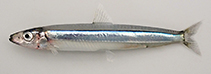
Épines dorsales (Total) : 0; Rayons mous dorsaux (Total) : 12 - 13; Épines anales: 0; Rayons mous anaux: 12 - 13. Maxilla toothed, triangular pre-maxillae, 2 supra-maxillae, second supra-maxilla asymmetrical (lower part larger than upper part), vertical striae on scales not meeting at center; W-shaped pelvic scute; few branchiostegal rays (6 or 7).
Body shape (shape guide): fusiform / normal; Cross section: oval.
Usually an inshore schooling species, inhabiting relatively clear waters of coastal, lagoon, and seaward reefs (Ref. 11230). Relative fecundity is 1596 eggs per unit body weight (Ref. 4383). Caught with beach seines, purse seines, ringnets and dipnets. Marketed fresh or dried-salted (Ref. 5213). Used as bait in the tuna fishery.
Whitehead, P.J.P., 1985. FAO Species Catalogue. Vol. 7. Clupeoid fishes of the world (suborder Clupeoidei). An annotated and illustrated catalogue of the herrings, sardines, pilchards, sprats, shads, anchovies and wolf-herrings. FAO Fish. Synop. 125(7/1):1-303. Rome: FAO. (Ref. 188)
Statut dans la liste rouge de l'IUCN (Ref. 130435: Version 2025-2 (Global))
Menace pour l'homme
Harmless
Utilisations par l'homme
Pêcheries: intérêt commercial mineur; appât: usually
Outils
Articles particuliers
Télécharger en XML
Sources Internet
Estimations basées sur des modèles
Indice de diversité phylogénétique (Réf.
82804): PD
50 = 0.5664 [Uniqueness, from 0.5 = low to 2.0 = high].
Bayesian length-weight: a=0.00513 (0.00321 - 0.00820), b=3.11 (2.97 - 3.25), in cm total length, based on LWR estimates for this species & (Sub)family-body (Ref.
93245).
Niveau trophique (Réf.
69278): 3.1 ±0.0 se; based on diet studies.
Résilience (Réf.
120179): Haut, temps minimum de doublement de population inférieur à 15 mois (K=0.41-0.44; tm<1; Fec=505).
Prior r = 1.19, 95% CL = 0.78 - 1.78, Based on 1 data-limited stock assessment.
Vulnérabilité de la pêche (Ref.
59153): Low vulnerability (10 of 100).
🛈
Vulnérabilité climatique (Ref.
125649): High vulnerability (62 of 100).
🛈
Nutriments (Ref.
124155): Calcium = 753 [190, 6,136] mg/100g; Iron = 9.36 [2.55, 36.03] mg/100g; Protein = 19.4 [16.7, 22.0] %; Omega3 = 0.29 [0.05, 1.73] g/100g; Selenium = 275 [32, 1,847] μg/100g; VitaminA = 4.7 [0.5, 49.5] μg/100g; Zinc = 6.21 [2.11, 17.03] mg/100g (wet weight);