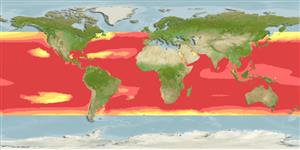
Entorno: milieu / zona climática / rango de profundidad / gama de distribución
Ecología
marino pelagic-oceanic; oceanodromo (Ref. 71039); rango de profundidad 0 - 1500 m (Ref. 117020), usually 0 - 500 m (Ref. 117020). Subtropical; 13°C - 29°C (Ref. 168); 52°N - 48°S, 180°W - 180°E
Atlantic, Indian and Pacific: in tropical and subtropical waters. Absent in the Mediterranean. Highly migratory species.
Longitud en la primera madurez / Tamaño / Peso / Edad
Madurez: Lm 112.5, range 100 - 125 cm
Max length : 250 cm TL macho / no sexado; (Ref. 27000); common length : 180 cm FL macho / no sexado; (Ref. 168); peso máximo publicado: 210.0 kg (Ref. 9987); edad máxima reportada: 17 años (Ref. 137697)
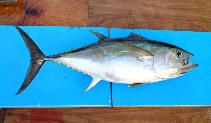
Espinas dorsales (total) : 13 - 14; Radios blandos dorsales (total) : 14 - 15; Espinas anales: 0; Radios blandos anales: 14; Vértebra: 39. This large species is distinguished by the following characters: robust, fusiform body, slightly compressed from side to side; total gill rakers on first gill arch 23-31; dorsal fins separated only by a narrow interspace, the second followed by 8-10 finlets; anal fin followed by 7-10 finlets; pectoral fins moderately long (22 to 31% of fork length) in large specimens (over 110 cm FL), but very long (as long as in Thunnus alalunga) in smaller specimens; 2 flaps (interpelvic process) between pelvic fins; very small scales on body; corselet of larger and thicker scales developed, but not very distinct; caudal peduncle very slender, with a strong lateral keel between 2 smaller keels; ventral surface of liver striated; swimbladder present. Colour of back metallic dark blue, lower sides and belly whitish; a lateral iridescent blue band runs along sides in live specimens; first dorsal fin deep yellow, second dorsal and anal fins light yellow, finlets bright yellow edged with black (Ref. 9684).
Body shape (shape guide): fusiform / normal; Cross section: oval.
Occur in areas where water temperatures range from 13°-29°C, but the optimum is between 17° and 22°C. Variation in occurrence is closely related to seasonal and climatic changes in surface temperature and thermocline. Juveniles and small adults school at the surface in mono-species groups or mixed with other tunas, may be associated with floating objects. Adults stay in deeper waters (Ref. 5377). Eggs and larvae are pelagic (Ref. 6390). Feed on a wide variety of fishes, cephalopods and crustaceans during the day and at night (Ref. 9340). Meat is highly prized and processed into sashimi in Japan. Marketed mainly canned or frozen (Ref. 9684), but also sold fresh (Ref. 9340).
Are multiple spawners that may spawn every 1 or 2 days over several months (Ref. 30330). They spawn over periods of the full moon (Ref. 6390). Spawn throughout the year in tropical waters (Ref. 6390).
Collette, B.B. and C.E. Nauen, 1983. FAO Species Catalogue. Vol. 2. Scombrids of the world. An annotated and illustrated catalogue of tunas, mackerels, bonitos and related species known to date. Rome: FAO. FAO Fish. Synop. 125(2):137 p. (Ref. 168)
Situación en la Lista Roja de la UICN (Ref. 130435: Version 2025-2 (Global))
Amenaza para el ser humano
Harmless
Usos humanos
Pesquerías: muy comercial; pesca deportiva: si
Herramientas
Informes especiales
Descargar XML
Fuentes de Internet
Estimaciones basadas en modelos
Temperatura preferida (Referencia
123201): 16.8 - 28.6, mean 26.6 °C (based on 3638 cells).
Índice de diversidad filogenética (Referencia
82804): PD
50 = 0.5039 [Uniqueness, from 0.5 = low to 2.0 = high].
Bayesian length-weight: a=0.01318 (0.01043 - 0.01666), b=3.03 (2.99 - 3.07), in cm total length, based on LWR estimates for this species (Ref.
93245).
Nivel trófico (Referencia
69278): 4.5 ±0.0 se; based on diet studies.
Generation time: 6.6 (4.4 - 10.4) years. Estimated as median ln(3)/K based on 12
growth studies.
Resiliencia (Referencia
120179): Medio, población duplicada en un tiempo mínimo de 1.4-4.4 años (K=0.11-0.23; tm=3; tmax=11; Fec=2 million).
Prior r = 0.52, 95% CL = 0.34 - 0.77, Based on 10 full stock assessments.
Vulnerabilidad pesquera (Ref.
59153): High vulnerability (56 of 100).
🛈
Vulnerabilidad climática (Ref.
125649): Moderate to high vulnerability (47 of 100).
🛈
Nutrientes (Ref.
124155): Calcium = 22.1 [12.0, 42.2] mg/100g; Iron = 2.65 [1.06, 6.93] mg/100g; Protein = 24 [23, 25] %; Omega3 = 0.453 [0.273, 0.754] g/100g; Selenium = 54.7 [17.4, 171.5] μg/100g; VitaminA = 19.6 [2.7, 180.1] μg/100g; Zinc = 0.278 [0.153, 0.561] mg/100g (wet weight);