>
Scombriformes (Mackerels) >
Arripidae (Australian salmon)
Etymology: Arripis: Latin, arripio, arripere = to take something suddenly.
More on author: Cuvier.
Ambiente: milieu / zona climatica / distribuzione batimetrica / gamma di distribuzione
Ecologia
marino; salmastro benthopelagico; distribuzione batimetrica 0 - 80 m (Ref. 6390). Subtropical; 27°S - 44°S
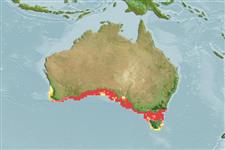
Eastern Indian Ocean: southern Australia from Western Australia to Victoria and Tasmania.
Lunghezza alla prima maturità / Dimensione / Peso / Età
Maturità: Lm ?, range 54 - ? cm
Max length : 96.0 cm SL maschio/sesso non determinato; (Ref. 33839); common length : 65.0 cm FL maschio/sesso non determinato; (Ref. 27977); peso massimo pubblicato: 10.5 kg (Ref. 27977); Età massima riportata: 9 anni (Ref. 27977)
Breve descrizione
Chiavi di identificazione | Morfologia | Morfometria
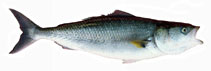
Spine dorsali (totale) : 9; Raggi dorsali molli (totale) : 15 - 19; Spine anali: 3; Raggi anali molli: 9 - 10; Vertebre: 25. Greyish or greenish black to steel-blue with yellow to blackish spots dorsally; silvery white ventrally. Pectoral fin pale yellowish, other fins translucent. Juveniles similar but with a greater number of spots and with dark fin margins. Length of upper lobe of caudal fin <29.9% (Ref. 9701).
Body shape (shape guide): fusiform / normal; Cross section: compressed.
Inhabit continental shelf waters including estuaries, bays and inlets (Ref. 6390). They school in shallow, open coastal waters, and can move over reefs in depths just sufficient to cover their bodies (Ref. 6390). Juveniles are found over soft substrates in shallow and sheltered coastal waters (Ref. 6390). They are often found over seagrass (e.g. Posidonia species) beds and in mangrove-lined (Avicennia species) creeks (Ref. 27967). Larger fish move into exposed, coastal waters, such as around rocky headlands, near reefs and the surf zone (Ref. 6390). Feeds on fishes (Ref. 2156). Minimum depth reported taken from Ref. 57178.
Ciclo vitale e comportamento di accoppiamento
Maturità | Riproduzione | Deposizione | Uova | Fecondità | Larve
They are probably serial batch spawners (Ref. 6390).
Paulin, C., 1993. Review of the Australian fish Family Arripididae (Percomorpha), with the description of a new species. Aust. J. Mar. Freshwat. Res. 44(3):459-471. (Ref. 9701)
Stato della Lista Rossa IUCN (Ref. 130435: Version 2025-2 (Global))
Usi umani
Pesca: commerciale; Pesce da pesca sportiva: si; esca: usually
Strumenti
Rapporti speciali
Scarica XML
Fonti Internet
Stime basate su modelli
Temperatura preferita (Fonte Biblio.
123201): 15 - 18.5, mean 17.1 °C (based on 162 cells).
Indice di diversità filogenetica (Fonte Biblio.
82804): PD
50 = 0.6250 [Uniqueness, from 0.5 = low to 2.0 = high].
Bayesian length-weight: a=0.00955 (0.00346 - 0.02636), b=3.01 (2.78 - 3.24), in cm total length, based on LWR estimates for this (Sub)family-body shape (Ref.
93245).
Livello trofico (Fonte Biblio.
69278): 4.4 ±0.75 se; based on food items.
Resilienza (Fonte Biblio.
120179): Medio, tempo minimo di raddoppiamento della popolazione 1.4 - 4.4 anni (K=0.26-0.30; tm=3-6; tmax=9).
Vulnerabilità della pesca (Ref.
59153): Moderate to high vulnerability (48 of 100).
🛈
Nutrienti (Ref.
124155): Calcium = 35.7 [22.2, 62.5] mg/100g; Iron = 0.755 [0.498, 1.167] mg/100g; Protein = 19.8 [17.7, 21.8] %; Omega3 = 0.361 [0.228, 0.572] g/100g; Selenium = 30.2 [16.9, 52.3] μg/100g; VitaminA = 18.9 [7.6, 48.3] μg/100g; Zinc = 0.591 [0.446, 0.808] mg/100g (wet weight);