Taxonomic Remarks
Provisionally valid species. When recognized, mainly considered as a subspecies of Merluccius gayi (Guichenot, 1848). Still more studies are needed to characterize it (March 2021).
Meio ambiente: milieu / Zona climática / intervalo de profundidade / faixa de distribuição
Ecologia
marinhas batidemersal; oceanódromo (Ref. 51243); intervalo de profundidade 50 - 500 m (Ref. 1371). Deep-water; 4°S - 14°S
Southeast Pacific: off the coast of Peru, from Paita southward to Huarmey.
Comprimento de primeira maturação / Tamanho / Peso / Idade
Maturidade: Lm 35.0 range ? - ? cm
Max length : 68.0 cm TL macho/indeterminado; (Ref. 1371); 115.0 cm TL (female); common length : 50.0 cm TL macho/indeterminado; (Ref. 1371); idade máx. registrada: 13 anos (Ref. 9722)
Descrição suscinta
Chaves de identificação | Morfologia | Morfometria
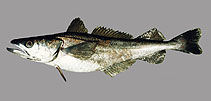
Espinhos dorsais (total) : 1; Raios dorsais (total) : 45 - 54; Espinhos anais: 0; Raios anais : 36 - 42. Caudal fin margin usually concave. Color is silvery on back, silvery whitish on belly. M. gayi gayi and M. gayi peruanus differ by the total number of vertebrae, total number of gill rakers and relative length of head (Ref. 1371).
Body shape (shape guide): elongated.
Occurs from the shallow continental shelf to the upper continental slope (Ref. 1371). Sometimes found off the bottom or in midwater (Ref. 1371). Marketed fresh and frozen and also used for fishmeal (Ref. 1371).
Ciclo de vida ou comportamento de acasalamento
Maturidade | Reprodução | Desova | Ovos | Fecundidade | Larvas
Espino, M., R. Castillo and F. Fernandez, 1995. Biology and fisheries of Peruvian hake (M. gayi peruanus). p. 339-363. In J. Alheit and T. J. Pitcher (eds.) Hake:biology, fisheries and markets. Chapmanand Hall, London, 478 p. (Ref. 9718)
Status na Lista Vermelha da UICN (Ref. 130435: Version 2025-2 (Global))
Ameaça para os humanos
Harmless
Uso pelos humanos
Pescarias: altamente comercial
Ferramentas
Relatórios especiais
Baixar XML
Fontes da internet
Estimativas baseadas em modelos
Índice de diversidade filogenética (Ref.
82804): PD
50 = 0.5000 [Uniqueness, from 0.5 = low to 2.0 = high].
Bayesian length-weight: a=0.00525 (0.00256 - 0.01076), b=3.09 (2.92 - 3.26), in cm total length, based on LWR estimates for this species & Genus-body shape (Ref.
93245).
Nível Trófico (Ref.
69278): 4.4 ±0.6 se; based on diet studies.
Resiliência (Ref.
120179): médio(a), tempo mínimo de duplicação da população 1,4 - 4,4 anos (K=0.19-0.21; tmax=13).
Vulnerabilidade da pesca (Ref.
59153): Moderate to high vulnerability (54 of 100).
🛈
Vulnerabilidade climática (Ref.
125649): Very high vulnerability (90 of 100).
🛈
Nutrientes (Ref.
124155): Calcium = 10.9 [5.5, 38.6] mg/100g; Iron = 0.326 [0.063, 0.892] mg/100g; Protein = 17 [16, 18] %; Omega3 = 0.141 [0.074, 0.262] g/100g; Selenium = 22.4 [10.1, 50.5] μg/100g; VitaminA = 14 [3, 62] μg/100g; Zinc = 0.245 [0.168, 0.379] mg/100g (wet weight);