>
Clupeiformes (Herrings) >
Dorosomatidae (Gizzard shads and sardinellas)
Etymology: Opisthonema: Greek, opisthe = behind + Greek,nema = filament (Ref. 45335).
Eponymy: Dr Audley Cecil Buller (1853–1894) was an American naturalist and collector of mammals, reptiles and fish. [...] (Ref. 128868), visit book page.
More on author: Regan.
Environnement : milieu / zone climatique / profondeur / gamme de distribution
Écologie
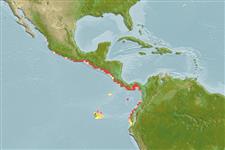
marin pelagic-neritic; profondeur 0 - 50 m (Ref. 188). Tropical; 25°N - 5°S, 109°W - 77°W (Ref. 188)
Eastern Pacific: Baja California, Mexico southward to Punta Sal and Punta Picos, Peru.
Taille / Poids / Âge
Maturité: Lm ? range ? - ? cm
Max length : 20.0 cm TL mâle / non sexé; (Ref. 55763); common length : 18.0 cm SL mâle / non sexé; (Ref. 188)
Description synthétique
Clés d'identification | Morphologie | Morphométrie
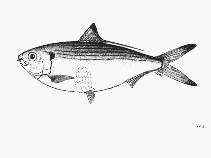
Épines dorsales (Total) : 0; Rayons mous dorsaux (Total) : 13 - 21; Épines anales: 0; Rayons mous anaux: 12 - 23. The filamentous last dorsal fin rays distinguish it from any other eastern Pacific genus. Separated from other eastern Pacific Opisthonema by having only 25 to 36 lower gill rakers in fishes over 14 cm standard length.
Body shape (shape guide): fusiform / normal; Cross section: compressed.
Forms schools. Apparently the least abundant of the eastern Pacific species of Opisthonema. Feeds on crustaceans and pteropods. Caught along with the other species of the genera.
Cycle de vie et comportement reproducteur
Maturité | Reproduction | Frai | Œufs | Fécondité | Larves
Whitehead, P.J.P., 1985. FAO Species Catalogue. Vol. 7. Clupeoid fishes of the world (suborder Clupeoidei). An annotated and illustrated catalogue of the herrings, sardines, pilchards, sprats, shads, anchovies and wolf-herrings. FAO Fish. Synop. 125(7/1):1-303. Rome: FAO. (Ref. 188)
Statut dans la liste rouge de l'IUCN (Ref. 130435: Version 2025-2 (Global))
Menace pour l'homme
Harmless
Utilisations par l'homme
Pêcheries: pêcheries vivrières
Outils
Articles particuliers
Télécharger en XML
Sources Internet
Estimations basées sur des modèles
Température préférée (Réf.
123201): 24.6 - 28.6, mean 27 °C (based on 34 cells).
Indice de diversité phylogénétique (Réf.
82804): PD
50 = 0.5312 [Uniqueness, from 0.5 = low to 2.0 = high].
Bayesian length-weight: a=0.00871 (0.00414 - 0.01834), b=3.06 (2.89 - 3.23), in cm total length, based on LWR estimates for this (Sub)family-body shape (Ref.
93245).
Niveau trophique (Réf.
69278): 3.2 ±0.38 se; based on food items.
Résilience (Réf.
120179): Haut, temps minimum de doublement de population inférieur à 15 mois (Preliminary K or Fecundity.).
Vulnérabilité de la pêche (Ref.
59153): Low vulnerability (10 of 100).
🛈