>
Clupeiformes (Herrings) >
Dorosomatidae (Gizzard shads and sardinellas)
Etymology: Opisthonema: Greek, opisthe = behind + Greek,nema = filament (Ref. 45335).
Taxonomic Remarks
Date & author Eschmeyer, pers. comm.
Ambiente: milieu / zona climatica / distribuzione batimetrica / gamma di distribuzione
Ecologia
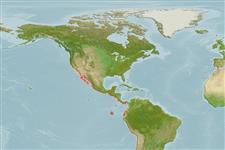
marino pelagic-neritic; distribuzione batimetrica 0 - 50 m (Ref. 188). Subtropical; 36°N - 6°S, 123°W - 77°W (Ref. 188)
Eastern Pacific: Los Angeles, California to Sechura Bay, Peru. (Included in at least some accounts of Opisthonema bulleri and especially Opisthonema libertate which used to be the only Pacific species recognized).
Dimensione / Peso / Età
Maturità: Lm ? range ? - ? cm
Max length : 30.0 cm TL maschio/sesso non determinato; (Ref. 55763); common length : 20.0 cm SL maschio/sesso non determinato; (Ref. 9291)
Breve descrizione
Chiavi di identificazione | Morfologia | Morfometria
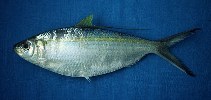
Spine dorsali (totale) : 0; Raggi dorsali molli (totale) : 13 - 21; Spine anali: 0; Raggi anali molli: 12 - 23. Body moderately deep and compressed; posterior edge of gill openings with two clearly visible, fleshy, protuberances; gill rakers numerous, 41 to 69 on ceratobranchial (in fish longer than 14 cm total length); last dorsal ray elongated and filamentous; back gray-green with silver-white flanks and a black spot behind the gill slit followed by a yellow lateral strip (Ref. 55763). The filamentous last dorsal fin ray distinguishes it from members of any other eastern Pacific clupeoid genus. Separated from other eastern Pacific Opisthonema by having 41 to 69 lower gill rakers in fishes over 14 cm standard length.
Body shape (shape guide): fusiform / normal; Cross section: compressed.
Usually found near shore, forming schools. Feeds on crustaceans and pteropods.
Ciclo vitale e comportamento di accoppiamento
Maturità | Riproduzione | Deposizione | Uova | Fecondità | Larve
Whitehead, P.J.P., 1985. FAO Species Catalogue. Vol. 7. Clupeoid fishes of the world (suborder Clupeoidei). An annotated and illustrated catalogue of the herrings, sardines, pilchards, sprats, shads, anchovies and wolf-herrings. FAO Fish. Synop. 125(7/1):1-303. Rome: FAO. (Ref. 188)
Stato della Lista Rossa IUCN (Ref. 130435: Version 2025-2 (Global))
Minaccia per l'uomo
Harmless
Usi umani
Pesca: scarso interesse commerciale; esca: occasionally
Strumenti
Rapporti speciali
Scarica XML
Fonti Internet
Stime basate su modelli
Temperatura preferita (Fonte Biblio.
123201): 20.5 - 28.4, mean 25.4 °C (based on 72 cells).
Indice di diversità filogenetica (Fonte Biblio.
82804): PD
50 = 0.5312 [Uniqueness, from 0.5 = low to 2.0 = high].
Bayesian length-weight: a=0.00776 (0.00448 - 0.01346), b=3.05 (2.90 - 3.20), in cm total length, based on LWR estimates for this species & (Sub)family-body (Ref.
93245).
Livello trofico (Fonte Biblio.
69278): 3.3 ±0.38 se; based on food items.
Resilienza (Fonte Biblio.
120179): Alto, tempo minimo di raddoppiamento della popolazione meno di 15 mesi (Preliminary K or Fecundity.).
Vulnerabilità della pesca (Ref.
59153): Low vulnerability (20 of 100).
🛈