>
Clupeiformes (Herrings) >
Dorosomatidae (Gizzard shads and sardinellas)
Etymology: Herklotsichthys: After Janus Adrian Herklots, Australian ichthyologist, 1820-1872.
Eponymy: Dr Geoffrey Alton Craig Herklots (1902–1986) was a British biologist, botanist and ornithologist at the University of Hong Kong (1928–1941). [...] Georg F Losse was a German biologist, ichthyologist, collector and Fishery Officer. [...] (Ref. 128868), visit book page.
Milieu: milieu / Klimaatzone / Diepte / verspreidingsgebied
Ecologie
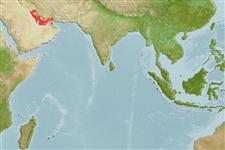
marien pelagic-neritic; diepte 0 - 50 m (Ref. 188). Subtropical; 31°N - 24°N, 47°E - 57°E (Ref. 188)
Western Indian Ocean: Persian Gulf, possibly also the Red Sea.
Grootte / Gewicht / Leeftijd
Maturiteit: Lm ? range ? - ? cm
Max length : 8.0 cm SL mannelijk / geslacht onbekend; (Ref. 188); common length : 7.0 cm SL mannelijk / geslacht onbekend; (Ref. 188)
Korte beschrijving
Determinatiesleutels | Morfologie | Morfometrie
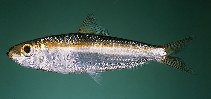
Dorsale stekels (totaal) : 0; Dorsale zachte stralen (totaal) : 13 - 21; Anale stekels: 0; Anale zachte stralen: 12 - 23. Closely resembles H. punctatus in shape, but the latter lacks a dark blotch on the dorsal fin and has small dark spots along the back and not on the flank. Distinguished from H. spilurus by its more slender body and spots along the flank. Possibly overlaps range of H. quadrimaculatus, which lacks spots on the flank and has elongate wing-like scales underneath paired pre-dorsal scales.
Body shape (shape guide): fusiform / normal; Cross section: compressed.
A schooling species found in coastal waters. Coastal pelagic (Ref. 68964).
Levenscyclus en paargedrag
Maturiteit | Voortplanting | Paaien | Eieren | Fecunditeit | Larven
Whitehead, P.J.P., 1985. FAO Species Catalogue. Vol. 7. Clupeoid fishes of the world (suborder Clupeoidei). An annotated and illustrated catalogue of the herrings, sardines, pilchards, sprats, shads, anchovies and wolf-herrings. FAO Fish. Synop. 125(7/1):1-303. Rome: FAO. (Ref. 188)
Status op de Rode Lijst van het IUCN (Ref. 130435: Version 2025-2 (Global))
Gevaar voor de mens
Harmless
Gebruik door de mens
Visserij: van potentieel belang
Tools
Speciale rapporten
Download XML
Internetbronnen
Schattingen op basis van modellen
Gewenste temperatuur (Ref.
123201): 23.5 - 27.6, mean 26.5 °C (based on 82 cells).
Fylogenetische diversiteitsindex (Ref.
82804): PD
50 = 0.5002 [Uniqueness, from 0.5 = low to 2.0 = high].
Bayesian length-weight: a=0.00871 (0.00414 - 0.01834), b=3.06 (2.89 - 3.23), in cm total length, based on LWR estimates for this (Sub)family-body shape (Ref.
93245).
Trofisch niveau (Ref.
69278): 3.1 ±0.3 se; based on size and trophs of closest relatives
Weerstandsvermogen (Ref.
120179): Hoog, minimale populatieverdubbelingstijd minder dan 15 maanden (Preliminary K or Fecundity.).
Kwetsbaarheid van de visserij (Ref.
59153): Low vulnerability (10 of 100).
🛈
Voedingsstoffen (Ref.
124155): Calcium = 298 [178, 669] mg/100g; Iron = 3.03 [1.63, 5.36] mg/100g; Protein = 19.3 [18.1, 20.5] %; Omega3 = 0.71 [0.38, 1.36] g/100g; Selenium = 18.7 [9.1, 40.1] μg/100g; VitaminA = 25.5 [9.1, 74.1] μg/100g; Zinc = 1.42 [0.94, 2.18] mg/100g (wet weight);