>
Ovalentaria/misc (Various families in series Ovalentaria) >
Plesiopidae (Roundheads) > Plesiopinae
Etymology: Assessor: Latin, assessor, -oris = the person that tkes part in some play.
Eponymy: Meaning ‘assistant’ or ‘helper’, the allusion is not explained, but might perhaps refer to Francis (Frank) A McNeill (1896–1969), Whitley’s colleague at the Australian Museum, who, as carcinologist, probably helped Whitley with his ichthylogical [...] (Ref. 128868), visit book page.
Ambiente: milieu / zona climática / intervalo de profundidade / gama de distribuição
Ecologia
marinhas associadas(os) a recifes; intervalo de profundidade 5 - 20 m (Ref. 9710), usually 5 - 20 m (Ref. 27115). Tropical; 27°C - 30°C (Ref. 130644)
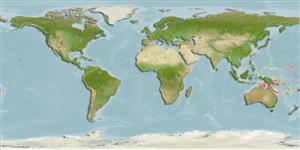
Western Central Pacific: Great Barrier Reef and Papua New Guinea.
Tamanho / Peso / Idade
Maturidade: Lm ? range ? - ? cm
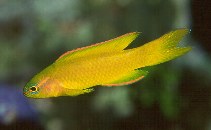
Max length : 6.0 cm TL macho/indeterminado; (Ref. 90102)
Espinhos dorsais (total) : 11; Raios dorsais moles (total) : 8 - 10; Espinhos anais: 3; Raios anais moles: 9 - 10.
Body shape (shape guide): elongated; Cross section: compressed.
Found near reefs (Ref. 7300). In aggregations in caves, often upside down. Males incubate the egg mass in their mouths (Ref. 9710). Also found in caves, crevices and under ledges (Ref 90102). Brreding in the aquarium is possible (Ref. 130644).
Ciclo de vida e comportamento de acasalamento
Maturidade | Reprodução | Desova | Ovos | Fecundidade | Larvas
Eggs are guarded by the male parent (Ref. 205).
Paxton, J.R., D.F. Hoese, G.R. Allen and J.E. Hanley, 1989. Pisces. Petromyzontidae to Carangidae. Zoological Catalogue of Australia, Vol. 7. Australian Government Publishing Service, Canberra, 665 p. (Ref. 7300)
Categoria na Lista Vermelha da IUCN (Ref. 130435: Version 2025-2 (Global))
Ameaça para o homem
Harmless
Utilização humana
Pescarias: espécies comerciais; Aquário: Espécies comerciais
Ferramentas
Relatórios especiais
Descarregue XML
Fontes da internet
Estimativas baseadas em modelos
Temperatura preferida (Ref.
123201): 26.5 - 28.1, mean 27.3 °C (based on 60 cells).
Índice de diversidade filogenética (Ref.
82804): PD
50 = 0.6250 [Uniqueness, from 0.5 = low to 2.0 = high].
Bayesian length-weight: a=0.00468 (0.00172 - 0.01274), b=3.18 (2.95 - 3.41), in cm total length, based on LWR estimates for this (Sub)family-body shape (Ref.
93245).
Nível Trófico (Ref.
69278): 3.4 ±0.2 se; based on size and trophs of closest relatives
Resiliência (Ref.
120179): Elevada, tempo mínimo de duplicação da população menor que 15 meses (Preliminary K or Fecundity.).
Vulnerabilidade da pesca (Ref.
59153): Low vulnerability (10 of 100).
🛈
Nutrientes (Ref.
124155): Calcium = 196 [99, 345] mg/100g; Iron = 0.913 [0.512, 1.574] mg/100g; Protein = 18.4 [17.2, 19.5] %; Omega3 = 0.111 [0.059, 0.206] g/100g; Selenium = 22.6 [9.6, 51.1] μg/100g; VitaminA = 167 [52, 511] μg/100g; Zinc = 2.28 [1.46, 3.36] mg/100g (wet weight);