Milieu: milieu / Klimaatzone / Diepte / verspreidingsgebied
Ecologie
marien rifbewoner; oceanodroom (Ref. 51243); diepte 1 - 100 m (Ref. 89707). Tropical; 36°N - 8°N, 98°W - 58°W (Ref. 5222)
Western Atlantic: North Carolina, USA to Paraíba, Brazil (Ref. 57756). The most common species of Epinephelus in the West Indies.
Lengte bij maturiteit / Grootte / Gewicht / Leeftijd
Maturiteit: Lm 25.0 range ? - ? cm
Max length : 76.0 cm TL mannelijk / geslacht onbekend; (Ref. 5222); common length : 40.0 cm TL mannelijk / geslacht onbekend; (Ref. 5217); max. gepubliceerd gewicht: 25.0 kg (Ref. 5217); max. gerapporteerde leeftijd: 22 Jaren (Ref. 31471)
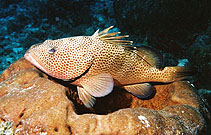
Dorsale stekels (totaal) : 11; Dorsale zachte stralen (totaal) : 15 - 16; Anale stekels: 3; Anale zachte stralen: 8. Scales cycloid except for a ctenoid patch of variable size in the pectoral region. Greenish gray to light brown on the back grading to white ventrally, with numerous well-spaced dull orange-red to brown spots on the head, body and fins. Five faint diagonal bars formed by darker spots on the sides. No saddle-shaped blotch on caudal peduncle or along base of dorsal fin (Ref. 26938); further characterized by having body depth contained 2.7-3.1 times in standard length; head length 2.3-2.4 times in standard length; evenly serrate preopercle, without salient angle; posterior nostril larger than anterior nostril (Ref. 89707).
Body shape (shape guide): fusiform / normal; Cross section: oval.
Found in shallow reefs and rocky bottoms, occurring down to depths of at least 100 meters (Ref. 89707). Usually solitary and territorial. Feed mainly on crabs (Calapa and Mithrax) and other crustaceans (alpheid shrimps and scyllarid lobsters), fishes (labrids and haemulids), and octopus. Some undergo sexual inversion at 28 cm TL; most fish larger than 40 cm are males. Important in terms of numbers caught and total weight of landings in the Caribbean.
Easily approached by divers (Ref. 9710). Hermaphrodite species. Excellent food fish (Ref. 26938). Readily caught on hook and line and easily speared (Ref. 13442).
Females rest on or close to the bottom, while males patrol around an area that consists of 1 to 5 females and defend this territory from other males. Form aggregation and reproduce almost exclusively within the aggregation period (Ref. 8557).
Heemstra, P.C. and J.E. Randall, 1993. FAO Species Catalogue. Vol. 16. Groupers of the world (family Serranidae, subfamily Epinephelinae). An annotated and illustrated catalogue of the grouper, rockcod, hind, coral grouper and lyretail species known to date. Rome: FAO. FAO Fish. Synop. 125(16):382 p. (Ref. 5222)
Status op de Rode Lijst van het IUCN (Ref. 130435: Version 2025-2 (Global))
Gevaar voor de mens
Reports of ciguatera poisoning (Ref. 31172)
Gebruik door de mens
Visserij: van groot commercieel belang; sportvis: ja
Tools
Speciale rapporten
Download XML
Internetbronnen
Schattingen op basis van modellen
Fylogenetische diversiteitsindex (Ref.
82804): PD
50 = 0.5000 [Uniqueness, from 0.5 = low to 2.0 = high].
Bayesian length-weight: a=0.01148 (0.01017 - 0.01296), b=3.04 (3.02 - 3.06), in cm total length, based on LWR estimates for this species (Ref.
93245).
Trofisch niveau (Ref.
69278): 3.8 ±0.3 se; based on diet studies.
Weerstandsvermogen (Ref.
120179): Gemiddeld, minimale populatieverdubbelingstijd 1,4-4,4 jaar (K=0.12-0.24; tm=3; tmax=17; Fec=96,000).
Prior r = 0.43, 95% CL = 0.28 - 0.64, Based on 2 data-limited stock assessments.
Kwetsbaarheid van de visserij (Ref.
59153): Moderate to high vulnerability (52 of 100).
🛈
Kwetsbaarheid voor het klimaat (Ref.
125649): Very high vulnerability (88 of 100).
🛈
Voedingsstoffen (Ref.
124155): Calcium = 21 [10, 46] mg/100g; Iron = 0.452 [0.243, 0.903] mg/100g; Protein = 18.5 [17.0, 19.9] %; Omega3 = 0.126 [0.078, 0.201] g/100g; Selenium = 47.2 [27.8, 83.6] μg/100g; VitaminA = 141 [40, 485] μg/100g; Zinc = 1.15 [0.81, 1.60] mg/100g (wet weight);