>
Clupeiformes (Herrings) >
Dorosomatidae (Gizzard shads and sardinellas)
Etymology: Sardinella: Latin and Greek, sarda = sardine; name related to the island of Sardinia; diminutive (Ref. 45335).
More on author: Valenciennes.
Environnement : milieu / zone climatique / profondeur / gamme de distribution
Écologie
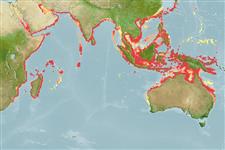
marin; saumâtre pelagic-neritic; profondeur 0 - 50 m (Ref. 188). Tropical; 31°N - 30°S, 31°E - 155°E (Ref. 188)
Indo-West Pacific: Red Sea, Persian Gulf, East African coasts, Madagascar eastward to Indonesia and the Arafura Sea (Ref. 9819), north to Taiwan and south to Papua New Guinea (Ref. 188).
Longueur à la première maturité / Taille / Poids / Âge
Maturité: Lm 9.0 range ? - ? cm
Max length : 15.0 cm TL mâle / non sexé; (Ref. 126292); common length : 10.0 cm SL mâle / non sexé; (Ref. 188); poids max. publié: 35.56 g (Ref. 126292)
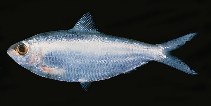
Épines dorsales (Total) : 0; Rayons mous dorsaux (Total) : 18 - 20; Épines anales: 0; Rayons mous anaux: 21 - 23. This species is distinguished by the following characters: body highly compressed, its depth 28.8-33.8% of standard length; interrupted longitudinal striae formation in lateral scales; prepelvic and post-pelvic scutes count 18 + 12-13 (usually 18+12); A 21-23 rays (usually 22); gill rakers 47–64 (Ref. 114969).
Body shape (shape guide): fusiform / normal; Cross section: compressed.
Found in coastal waters (Ref. 30573). Forms schools. Feeds on zooplankton and phytoplankton (Ref. 30573). Marketed fresh, dried, dried-salted, and made into fish balls.
Cycle de vie et comportement reproducteur
Maturité | Reproduction | Frai | Œufs | Fécondité | Larves
Stern, N., B. Rinkevich and M. Goren, 2016. Integrative approach revises the frequently misidentified species of Sardinella (Clupeidae) of the Indo-West Pacific Ocean. J. Fish Biol. 89(5):2282-2305. (Ref. 114969)
Statut dans la liste rouge de l'IUCN (Ref. 130435: Version 2025-2 (Global))
Menace pour l'homme
Harmless
Utilisations par l'homme
Pêcheries: commercial
Outils
Articles particuliers
Télécharger en XML
Sources Internet
Estimations basées sur des modèles
Température préférée (Réf.
123201): 24.9 - 29.2, mean 28.2 °C (based on 1450 cells).
Indice de diversité phylogénétique (Réf.
82804): PD
50 = 0.5000 [Uniqueness, from 0.5 = low to 2.0 = high].
Bayesian length-weight: a=0.00501 (0.00319 - 0.00786), b=2.99 (2.86 - 3.12), in cm total length, based on LWR estimates for this species & Genus-body shape (Ref.
93245).
Niveau trophique (Réf.
69278): 2.6 ±0.14 se; based on food items.
Résilience (Réf.
120179): Haut, temps minimum de doublement de population inférieur à 15 mois (K=1.10-2.03).
Vulnérabilité de la pêche (Ref.
59153): Low vulnerability (10 of 100).
🛈
Nutriments (Ref.
124155): Calcium = 158 [71, 268] mg/100g; Iron = 1.26 [0.69, 2.23] mg/100g; Protein = 21 [20, 22] %; Omega3 = 0.176 [0.088, 0.367] g/100g; Selenium = 92.7 [41.8, 187.4] μg/100g; VitaminA = 58.7 [16.9, 208.5] μg/100g; Zinc = 1.85 [1.21, 2.78] mg/100g (wet weight); based on
nutrient studies.