>
Clupeiformes (Herrings) >
Dorosomatidae (Gizzard shads and sardinellas)
Etymology: Sardinella: Latin and Greek, sarda = sardine; name related to the island of Sardinia; diminutive (Ref. 45335).
More on author: Cuvier.
Environnement : milieu / zone climatique / profondeur / gamme de distribution
Écologie
marin pelagic-neritic; amphidrome (Ref. 51243); profondeur 0 - 50 m (Ref. 188). Tropical; 37°N - 27°S, 33°E - 149°W
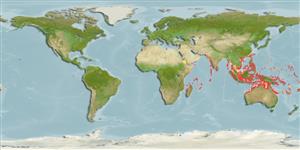
Indo-West Pacific: Gulf of Aden south to Inhaca Island, Mozambique and Madagascar and east to the Arabian Sea and northwestern India (apparently not found south of Bombay nor in northern Bay of Bengal), north to Ibaraki Prefecture Japan; then from Indonesia (but not in South China Sea) to Tahiti.
Taille / Poids / Âge
Maturité: Lm ? range ? - ? cm
Max length : 20.3 cm SL mâle / non sexé; (Ref. 3605); common length : 10.0 cm SL mâle / non sexé; (Ref. 188)
Épines dorsales (Total) : 0; Rayons mous dorsaux (Total) : 13 - 21; Épines anales: 0; Rayons mous anaux: 12 - 23. Body depth usually not much more than 30% of standard length; scutes 27 to 31. The jet black caudal tips distinguish S. melanura from all other species of Sardinella except S. atricauda (scutes 32 to 35), S. hualiensis (dark spot at dorsal fin origin, scales fimbriated and with small perforations) and S. fijiense (gill rakers 87 to 134).
Body shape (shape guide): fusiform / normal; Cross section: compressed.
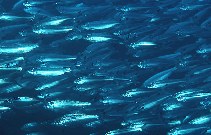
Form schools in coastal waters (Ref. 188, 75154). Regarded a robust and very good bait in the tuna fishery.
Cycle de vie et comportement reproducteur
Maturité | Reproduction | Frai | Œufs | Fécondité | Larves
Whitehead, P.J.P., 1985. FAO Species Catalogue. Vol. 7. Clupeoid fishes of the world (suborder Clupeoidei). An annotated and illustrated catalogue of the herrings, sardines, pilchards, sprats, shads, anchovies and wolf-herrings. FAO Fish. Synop. 125(7/1):1-303. Rome: FAO. (Ref. 188)
Statut dans la liste rouge de l'IUCN (Ref. 130435: Version 2025-2 (Global))
Menace pour l'homme
Harmless
Utilisations par l'homme
Pêcheries: intérêt commercial mineur; appât: usually
Outils
Articles particuliers
Télécharger en XML
Sources Internet
Estimations basées sur des modèles
Température préférée (Réf.
123201): 25.2 - 29.1, mean 28.2 °C (based on 1254 cells).
Indice de diversité phylogénétique (Réf.
82804): PD
50 = 0.5000 [Uniqueness, from 0.5 = low to 2.0 = high].
Bayesian length-weight: a=0.00851 (0.00713 - 0.01016), b=3.05 (3.02 - 3.08), in cm total length, based on LWR estimates for this species (Ref.
93245).
Generation time: 1.6 ( na - na) years. Estimated as median ln(3)/K based on 2
growth studies.
Résilience (Réf.
120179): Haut, temps minimum de doublement de population inférieur à 15 mois (tmax=4; k >0.7).
Vulnérabilité de la pêche (Ref.
59153): Low vulnerability (20 of 100).
🛈
Nutriments (Ref.
124155): Calcium = 252 [133, 380] mg/100g; Iron = 1.82 [1.07, 3.32] mg/100g; Protein = 20.5 [19.6, 21.5] %; Omega3 = 0.293 [0.141, 0.586] g/100g; Selenium = 85.8 [44.9, 169.5] μg/100g; VitaminA = 32 [10, 96] μg/100g; Zinc = 1.17 [0.84, 1.62] mg/100g (wet weight);