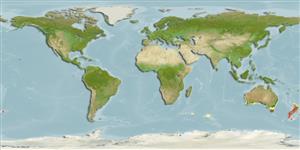
Environnement : milieu / zone climatique / profondeur / gamme de distribution
Écologie
marin démersal; profondeur 22 - 222 m (Ref. 58489), usually ? - 100 m (Ref. 30464). Temperate
Southwest Pacific: in temperate waters.
Taille / Poids / Âge
Maturité: Lm ? range ? - ? cm
Max length : 35.0 cm TL mâle / non sexé; (Ref. 30464); common length : 20.0 cm TL mâle / non sexé; (Ref. 30464)
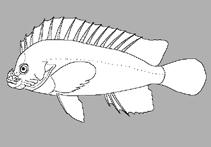
Occur in the continental shelf (Ref. 7300, 75154). Benthic (Ref. 75154). Sedentary fishes that swim slowly and spend much of their time resting on the bottom. They use the long snout for probing in crevices, seaweed and sand for crabs, worms, and other benthic invertebrates (Ref. 30464). Neither anterolateral glandural groove nor venom gland is present (Ref. 57406).
Cycle de vie et comportement reproducteur
Maturité | Reproduction | Frai | Œufs | Fécondité | Larves
Paxton, J.R., D.F. Hoese, G.R. Allen and J.E. Hanley, 1989. Pisces. Petromyzontidae to Carangidae. Zoological Catalogue of Australia, Vol. 7. Australian Government Publishing Service, Canberra, 665 p. (Ref. 7300)
Statut dans la liste rouge de l'IUCN (Ref. 130435: Version 2025-2 (Global))
Menace pour l'homme
Harmless
Utilisations par l'homme
Pêcheries: sans intérêt
Outils
Articles particuliers
Télécharger en XML
Sources Internet
Estimations basées sur des modèles
Température préférée (Réf.
123201): 10 - 18.1, mean 15.1 °C (based on 157 cells).
Indice de diversité phylogénétique (Réf.
82804): PD
50 = 0.5312 [Uniqueness, from 0.5 = low to 2.0 = high].
Bayesian length-weight: a=0.01995 (0.00906 - 0.04395), b=3.01 (2.83 - 3.19), in cm total length, based on all LWR estimates for this body shape (Ref.
93245).
Niveau trophique (Réf.
69278): 3.8 ±0.4 se; based on size and trophs of closest relatives
Vulnérabilité de la pêche (Ref.
59153): Low vulnerability (25 of 100).
🛈