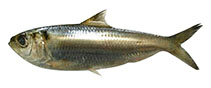
>
Clupeiformes (Herrings) >
Dorosomatidae (Gizzard shads and sardinellas)
Etymology: Sardinella: Latin and Greek, sarda = sardine; name related to the island of Sardinia; diminutive (Ref. 45335); tawilis: tawilis is a local tagalog name (Ref. 2930).
More on author: Herre.
Entorno: milieu / zona climática / rango de profundidad / gama de distribución
Ecología
; agua dulce pelágico; no migratorio. Tropical; 18°N - 14°N
Asia: endemic to Lake Taal (formerly Lake Bombon), Luzon, Philippines. This freshwater lake, linked to the sea via the Pansipit River, was part of Balayan Bay, South China Sea, and was formed by a series of volcanic eruptions in the 18th century (Ref. 5522).
Longitud en la primera madurez / Tamaño / Peso / Edad
Madurez: Lm 7.9 range ? - ? cm
Deprecated: number_format(): Passing null to parameter #1 ($num) of type float is deprecated in /var/www/html/includes/common.lib.php on line 1833
Max length : 12.0 cm TL macho / no sexado; (Ref. 5520); 15.2 cm TL (female); peso máximo publicado: 0.00 g
Descripción breve
Claves de identificación | Morfología | Morfometría
Espinas dorsales (total) : 0; Radios blandos dorsales (total) : 15 - 18; Espinas anales: 0; Radios blandos anales: 18 - 21; Vértebra: 39 - 42. Total scutes 28 to 30. gill rakers slender, long and numerous (Ref. 5520).
Body shape (shape guide): fusiform / normal; Cross section: compressed.
Inhabits lakes. This is the only species of Sardinella that is apparently found only, or even mainly, in freshwater. Presumably schooling. Also caught using ring nets (Ref. 5520). Mainly caught by gill net, beach seine, ring net and motorized push net (Refs.81494, 80728, 5520). Eaten fresh or dried (Ref. 5517). Is threatened by overfishing (Ref. 6308).
Whitehead, P.J.P., 1985. FAO Species Catalogue. Vol. 7. Clupeoid fishes of the world (suborder Clupeoidei). An annotated and illustrated catalogue of the herrings, sardines, pilchards, sprats, shads, anchovies and wolf-herrings. FAO Fish. Synop. 125(7/1):1-303. Rome: FAO. (Ref. 188)
Situación en la Lista Roja de la UICN (Ref. 130435: Version 2025-2 (Global))
Endangered (EN) (A2bd; B1ab(iii,v)+2ab(iii,v)); Date assessed: 28 February 2017
Amenaza para el ser humano
Harmless
Usos humanos
Pesquerías: pesquerías de subsistencia
Herramientas
Informes especiales
Descargar XML
Fuentes de Internet
Estimaciones basadas en modelos
Índice de diversidad filogenética (Referencia
82804): PD
50 = 0.5000 [Uniqueness, from 0.5 = low to 2.0 = high].
Bayesian length-weight: a=0.00832 (0.00471 - 0.01469), b=2.98 (2.83 - 3.13), in cm total length, based on LWR estimates for this species & Genus-body shape (Ref.
93245).
Nivel trófico (Referencia
69278): 3.0 ±0.0 se; based on diet studies.
Resiliencia (Referencia
120179): Alto, población duplicada en un tiempo mínimo inferior a 15 meses (Preliminary K or Fecundity.).
Vulnerabilidad pesquera (Ref.
59153): Low vulnerability (22 of 100).
🛈