Entorno: milieu / zona climática / rango de profundidad / gama de distribución
Ecología
marino asociado a arrecife; no migratorio; rango de profundidad 10 - 300 m (Ref. 9790). Tropical
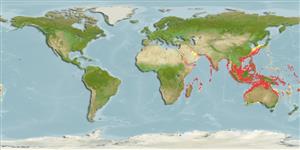
Indo-West Pacific: widespread, from the New Hebrides to Papua New Guinea, north to Taiwan, through Indonesia to Thailand, Pakistan, the Red Sea, and South Africa. Replaced by Cociella crocodilus from southern China to Japan and by Cociella hutchinsi in northern Australia (Ref. 37816).
Tamaño / Peso / Edad
Madurez: Lm ? range ? - ? cm
Max length : 35.0 cm TL macho / no sexado; (Ref. 9790); common length : 25.0 cm TL macho / no sexado; (Ref. 9790)
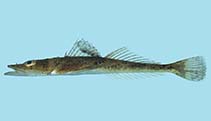
Espinas dorsales (total) : 9; Radios blandos dorsales (total) : 10 - 12; Espinas anales: 0; Radios blandos anales: 11 - 12. Uppermost preopercular spine reaching only about half-way to the opercular margin. Preorbital spine present. Infraorbital ridge usually smooth over anterior 1/2 of eye. Suborbital ridge lacking spines behind eye. Interopercular flap present. Iris lappet simple, semicircular. Numerous small dark spots on back reaching to below the lateral line, more widely scattered posteriorly. Has 5-6 dark bands across the back, but small juveniles may have only a broad saddle crossing the spinous dorsal fin and a narrow one near the rear of the soft dorsal fin (Ref. 37816).
Body shape (shape guide): elongated.
Frequents shallow areas in depths of 10 m or less. Taken in trawl fisheries at depths from 23 to 250 m. Reported from a trap in the Gulf of Aqaba at a depth of 300 m. Young to juvenile stages utilize mangrove habitat (Ref. 9790). Adults occur in silty sand habitats from the shallows to a depth of 300 m (Ref. 37816). Also found in coastal sand patches, near coral reefs but more often on offshore (Ref 90102).
Ciclo vital y comportamiento de apareamiento
Madurez | Reproducción | Puesta | Huevos | Fecundidad | Larva
Knapp, L.W., 1999. Platycephalidae. Flatheads. p. 2385-2421. In K.E. Carpenter and V.H. Niem (eds.) FAO species identification guide for fishery purposes. The living marine resources of the Western Central Pacific. Volume 4. Bony fishes part 2 (Mugilidae to Carangidae). FAO, Rome. (Ref. 9790)
Situación en la Lista Roja de la UICN (Ref. 130435: Version 2025-2 (Global))
Amenaza para el ser humano
Harmless
Usos humanos
Pesquerías: escaso valor comercial
Herramientas
Informes especiales
Descargar XML
Fuentes de Internet
Estimaciones basadas en modelos
Temperatura preferida (Referencia
123201): 18.8 - 28.1, mean 25.6 °C (based on 1088 cells).
Índice de diversidad filogenética (Referencia
82804): PD
50 = 0.5312 [Uniqueness, from 0.5 = low to 2.0 = high].
Bayesian length-weight: a=0.00427 (0.00219 - 0.00832), b=3.11 (2.94 - 3.28), in cm total length, based on LWR estimates for this (Sub)family-body shape (Ref.
93245).
Nivel trófico (Referencia
69278): 3.8 ±0.7 se; based on size and trophs of closest relatives
Resiliencia (Referencia
120179): Medio, población duplicada en un tiempo mínimo de 1.4-4.4 años (Preliminary K or Fecundity.).
Vulnerabilidad pesquera (Ref.
59153): Low vulnerability (25 of 100).
🛈
Nutrientes (Ref.
124155): Calcium = 48.7 [24.6, 138.2] mg/100g; Iron = 0.602 [0.280, 1.395] mg/100g; Protein = 17.8 [15.8, 19.9] %; Omega3 = 0.164 [0.071, 0.465] g/100g; Selenium = 54.3 [25.3, 141.5] μg/100g; VitaminA = 80.2 [28.8, 224.0] μg/100g; Zinc = 1.08 [0.69, 1.65] mg/100g (wet weight);