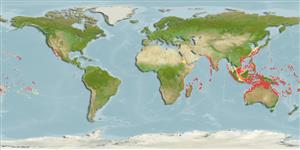
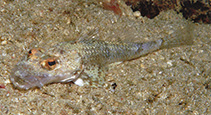
Umwelt: Milieu / Klimazone / Tiefenbereich / Verbreitungsgebiet
Ökologie
seewasser demersal; standorttreu; tiefenbereich 15 - 110 m (Ref. 9790). Tropical
Indo-West Pacific: widespread, from off Natal, South Africa to Karachi, Maldives, South China Sea, Philippines, Irian Barat (Teluk Berau), Northwest Shelf of Australia, Timor and Arafura seas, Great Barrier Reef, Guadalcanal and Tonga.
Größe / Gewicht / Alter
Geschlechtsreife: Lm ? range ? - ? cm
Max length : 11.0 cm TL Männchen/unbestimmt; (Ref. 9790); common length : 7.0 cm TL Männchen/unbestimmt; (Ref. 9790)
Rückenflossenstacheln (insgesamt) : 9; Rückenflossenweichstrahlen (insgesamt) : 11; Afterflossenstacheln: 0; Afterflossenweichstrahlen: 10 - 11. No supraocular cirrus present. Infraorbital ridge entirely serrated over eye. Preopercular spines 3-5, slanting towards midline. Suborbital ridge with no smooth notch under eye. Antorbital margin with 2 antrorse spines. Lower side of head unicarinate. Lateral line scales frequently 30 or 31, anterior 2-6 (frequently 3) scales bearing spines. Iris lappet bilobed or crenate. Upper surface of eye smooth, no cirrus present. Pelvic fin with a prominent dark blotch in middle, a smaller dark blotch near base.
Body shape (shape guide): elongated.
Taken by trawl over sand or coral rubble bottom at 15 to 110 m; also taken by SCUBA off coral or rocky slopes (Ref. 9790). Occurs near reefs (Ref 90102).
Lebenszyklus und Paarungsverhalten
Geschlechtsreife | Fortpflanzung | Ablaichen | Eier | Fruchtbarkeit | Larven
Knapp, L.W., 1999. Platycephalidae. Flatheads. p. 2385-2421. In K.E. Carpenter and V.H. Niem (eds.) FAO species identification guide for fishery purposes. The living marine resources of the Western Central Pacific. Volume 4. Bony fishes part 2 (Mugilidae to Carangidae). FAO, Rome. (Ref. 9790)
IUCN Rote Liste Status (Ref. 130435: Version 2025-2 (Global))
Bedrohung für Menschen
Harmless
Nutzung durch Menschen
Fischereien: nicht kommerziell
Tools
Zusatzinformationen
Download XML
Internet Quellen
Schätzungen auf der Grundlage von Modellen
Bevorzugte Temperatur (Ref.
123201): 22.1 - 28.4, mean 27 °C (based on 507 cells).
Phylogenetischer Diversitätsindex (Ref.
82804): PD
50 = 0.5039 [Uniqueness, from 0.5 = low to 2.0 = high].
Bayesian length-weight: a=0.00427 (0.00219 - 0.00832), b=3.11 (2.94 - 3.28), in cm total length, based on LWR estimates for this (Sub)family-body shape (Ref.
93245).
Trophische Ebene (Ref.
69278): 3.5 ±0.6 se; based on size and trophs of closest relatives
Widerstandsfähigkeit (Ref.
120179): hoch, Verdopplung der Population dauert weniger als 15 Monate. (Preliminary K or Fecundity.).
Anfälligkeit der Fischerei (Ref.
59153): Low vulnerability (10 of 100).
🛈