>
Perciformes/Scorpaenoidei (Scorpionfishes) >
Triglidae (Searobins) > Pterygotriglinae
Etymology: Pterygotrigla: Greek, pterigion, diminutive of pteryx = wing, fin + Greek, trigla, es = red mullet (Ref. 45335).
More on author: Fowler.
Umwelt: Milieu / Klimazone / Tiefenbereich / Verbreitungsgebiet
Ökologie
seewasser bathydemersal; tiefenbereich 265 - 512 m (Ref. 95016). Deep-water
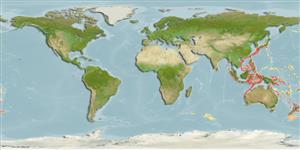
Eastern Indian Ocean to West Pacific: Philippines, Arafura Sea southward to Rowley Shoals, Western Australian Shelf.
Größe / Gewicht / Alter
Geschlechtsreife: Lm ? range ? - ? cm
Max length : 10.8 cm SL Männchen/unbestimmt; (Ref. 95016)
Kurzbeschreibung
Bestimmungsschlüssel | Morphologie | Morphometrie
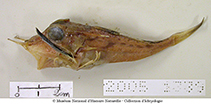
Rückenflossenstacheln (insgesamt) : 8 - 9; Rückenflossenweichstrahlen (insgesamt) : 12; Afterflossenweichstrahlen: 11 - 12; Wirbelzahl: 27. This species is distinguished by the following characters: absence of antrorse AIO spine; AIO long and slender (30% HL); pectoral fin long extending well beyond anal fin origin (53-54% SL); eye small (11-15% SL); pterygiophores exposed along base of D1 as large plates (excluding one in advance of first D1 spine) and D2 rays have small spines at ray bases that are directed anteriorly (Ref. 95016).
Body shape (shape guide): fusiform / normal; Cross section: oval.
Inhabits continental shelves and insular areas. Rare (Ref. 9771). Benthic (Ref. 75154).
Lebenszyklus und Paarungsverhalten
Geschlechtsreife | Fortpflanzung | Ablaichen | Eier | Fruchtbarkeit | Larven
Richards, W.J. and T. Yato, 2014. Revision of the subgenus Parapterygotrigla (Pisces: Triglidae: Pterygotrigla). Zootaxa 3768(1):23-42. (Ref. 95016)
IUCN Rote Liste Status (Ref. 130435: Version 2025-2 (Global))
Bedrohung für Menschen
Harmless
Nutzung durch Menschen
Fischereien: kommerzielles potential
Tools
Zusatzinformationen
Download XML
Internet Quellen
Schätzungen auf der Grundlage von Modellen
Bevorzugte Temperatur (Ref.
123201): 7.1 - 13.7, mean 10.3 °C (based on 108 cells).
Phylogenetischer Diversitätsindex (Ref.
82804): PD
50 = 0.5000 [Uniqueness, from 0.5 = low to 2.0 = high].
Bayesian length-weight: a=0.00955 (0.00411 - 0.02221), b=3.05 (2.84 - 3.26), in cm total length, based on LWR estimates for this (Sub)family-body shape (Ref.
93245).
Trophische Ebene (Ref.
69278): 3.5 ±0.5 se; based on size and trophs of closest relatives
Widerstandsfähigkeit (Ref.
120179): hoch, Verdopplung der Population dauert weniger als 15 Monate. (Preliminary K or Fecundity.).
Anfälligkeit der Fischerei (Ref.
59153): Low vulnerability (10 of 100).
🛈