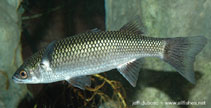
Umwelt: Milieu / Klimazone / Tiefenbereich / Verbreitungsgebiet
Ökologie
seewasser; süßwasser; brackwasser demersal; katadrom (Ref. 97775); tiefenbereich 0 - 5 m (Ref. 86942). Tropical
Asia: Celebes, New Caledonia, New Hebrides, and Fiji. Also from Okinawa, Ryukyu Islands (Ref. 96268).
Größe / Gewicht / Alter
Geschlechtsreife: Lm ? range ? - ? cm
Max length : 32.5 cm TL Männchen/unbestimmt; (Ref. 9812); common length : 20.0 cm TL Männchen/unbestimmt; (Ref. 9812)
Very little available data. Possibly ascending some way up rivers. Probably taken incidentally or as part of subsistence fisheries in rivers. Oviparous, eggs are pelagic and non-adhesive (Ref. 205).
Lebenszyklus und Paarungsverhalten
Geschlechtsreife | Fortpflanzung | Ablaichen | Eier | Fruchtbarkeit | Larven
Harrison, I.J. and H. Senou, 1997. Order Mugiliformes. Mugilidae. Mullets. p. 2069-2108. In K.E. Carpenter and V.H. Niem (eds.) FAO species identification guide for fishery purposes. The living marine resources of the Western Central Pacific. Volume 4. Bony fishes part 2 (Mugilidae to Carangidae). FAO, Rome. (Ref. 9812)
IUCN Rote Liste Status (Ref. 130435: Version 2025-2 (Global))
Bedrohung für Menschen
Harmless
Nutzung durch Menschen
Aquakultur: zukünftige nutzung
Tools
Zusatzinformationen
Download XML
Internet Quellen
Schätzungen auf der Grundlage von Modellen
Phylogenetischer Diversitätsindex (Ref.
82804): PD
50 = 0.6250 [Uniqueness, from 0.5 = low to 2.0 = high].
Bayesian length-weight: a=0.01175 (0.00553 - 0.02496), b=2.96 (2.79 - 3.13), in cm total length, based on LWR estimates for this (Sub)family-body shape (Ref.
93245).
Trophische Ebene (Ref.
69278): 2.5 ±0.2 se; based on size and trophs of closest relatives
Widerstandsfähigkeit (Ref.
120179): mittel, Verdopplung der Population dauert 1,4 - 4,4 Jahre. (Preliminary K or Fecundity.).
Anfälligkeit der Fischerei (Ref.
59153): Low vulnerability (23 of 100).
🛈