>
Carangiformes (Jacks) >
Carangidae (Jacks and pompanos) > Caranginae
Etymology: Alepes: Greek, alepis, -idos = without scales (Ref. 45335).
Miljö: miljö / Klimatzon / djupintervall / distributionsområde
Ekologi
marina bottenlevande; djupintervall 5 - 80 m (Ref. 86942). Tropical
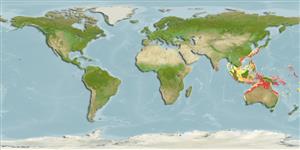
Western Central Pacific: endemic to northern Australia, from Exmouth Gulf, Western Australia to Wide Bay, Queensland.
Storlek / Vikt / Ålder
Könsmognad: Lm ? range ? - ? cm
Max length : 29.5 cm TL hane/ej könsbestämd; (Ref. 9894)
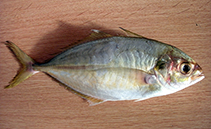
Taggstrålar i ryggfenan (totalt) : 8; Mjukstrålar i ryggfenan (totalt) : 24 - 26; Taggstrålar i analfenan: 3; Mjukstrålar i analfenan: 20 - 22; Ryggkotor: 24. This species is distinguished by the following characters: adipose eyelid well developed on posterior half of the eye only; upper jaw narrowly rounded posteriorly, with supramaxilla relatively small without an anterior spine-like extension; gill rakers (including rudiments) 8-10 + 18-21 = 27-30. Colour in life green to bluish green above, silvery to white below, a diffuse dusky blotch on margin of opercle, not bordered above by a white spot; interradial membranes of spinous dorsal fin hyaline to dusky; spinous and second dorsal, anal, and caudal fins dusky yellow, with anterior rays of second dorsal and anal fins often with white tips; caudal-fin lobes often with dark tips; pelvic fins white and pectoral fins hyaline; juveniles with 7 dark bands on body (Ref. 9894).
Body shape (shape guide): fusiform / normal; Cross section: compressed.
Adults occur in inshore waters of the continental shelf (Ref. 75154). Feeds primarily on small invertebrates, primarily microscopic crustaceans and molluscs. Caught mainly on hook-and-line (Ref. 9894).
Livscykel och parningsbeteende
Könsmognad | Reproduktion | Lek | Ägg | Fekunditet | Larver
Smith-Vaniz, W.F., 1999. Carangidae. Jacks and scads (also trevallies, queenfishes, runners, amberjacks, pilotfishes, pampanos, etc.). p. 2659-2756. In K.E. Carpenter and V.H. Niem (eds.) FAO species identification guide for fishery purposes. The living marine resources of the Western Central Pacific. Vol. 4. Bony fishes part 2 (Mugilidae to Carangidae). Rome, FAO. 2069-2790 p. (Ref. 9894)
Status på IUCN:s rödlista (Ref. 130435: Version 2025-2 (Global))
Hot mot människor
Harmless
Mänskliga användningsområden
Fiskeri: kommersiell
Verktyg
Särskilda rapporter
Ladda ner XML
Internet-källor
Uppskattningar baserade på modeller
Önskad temperatur (Ref.
123201): 24.5 - 28.7, mean 27.7 °C (based on 544 cells).
Index för fylogenetisk mångfald (Ref.
82804): PD
50 = 0.5312 [Uniqueness, from 0.5 = low to 2.0 = high].
Bayesian length-weight: a=0.01318 (0.00635 - 0.02739), b=2.96 (2.79 - 3.13), in cm total length, based on LWR estimates for this (Sub)family-body shape (Ref.
93245).
Trofisk nivå (Ref.
69278): 3.4 ±0.5 se; based on size and trophs of closest relatives
Resiliens (Ref.
120179): Hög, lägsta populationsfördubblingstid mindre än 15 månader (Preliminary K or Fecundity.).
Sårbarhet i fisket (Ref.
59153): Low vulnerability (20 of 100).
🛈