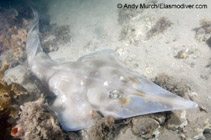
Élasmobranches (requins et raies) (sharks and rays) >
Rhinopristiformes (Shovelnose rays) >
Trygonorrhinidae (Banjo rays, Fiddler rays)
Etymology: Aptychotrema: Greek, a = without + Greek, ptyx, ptychos = fold + Greek, trema = hole (Ref. 45335).
More on author: Shaw.
Taxonomic Remarks
Authorship to be checked again in new CoF version. See Synonyms for another opinion.
Environnement : milieu / zone climatique / profondeur / gamme de distribution
Écologie
marin; saumâtre démersal; profondeur ? - 220 m (Ref. 114953). Subtropical; 18°S - 37°S, 145°E - 155°E (Ref. 114953)
Western Pacific: endemic to Australia.
Taille / Poids / Âge
Maturité: Lm ? range ? - ? cm
Max length : 100.0 cm TL mâle / non sexé; (Ref. 12951); 120.0 cm TL (female)
Found on soft bottoms off beaches, lower parts of estuaries and offshore (Ref. 9909). Feeds on bottom crustaceans, mollusks, and fishes (Ref. 9909). Males mature at 60-68 cm TL, females at 54-66 cm TL; birth size at 13-15 TL. Produces 4-18 pups after 3-5 month gestation, usually around November and December (Ref. 114953). Caught in nets (Ref. 9909). Marketed fresh (Ref. 9909).
Cycle de vie et comportement reproducteur
Maturité | Reproduction | Frai | Œufs | Fécondité | Larves
Ovoviviparous with up to 4 in a litter. Size at birth about 13 cm.
Compagno, L.J.V. and P.R. Last, 1999. Rhinobatidae. Guitarfishes. p. 1423-1430. In K.E. Carpenter and V.H. Niem (eds.) FAO identification guide for fishery purposes. The living marine resources of the Western Central Pacific. Rome, FAO. (Ref. 9909)
Statut dans la liste rouge de l'IUCN (Ref. 130435: Version 2025-2 (Global))
Menace pour l'homme
Harmless
Utilisations par l'homme
Pêcheries: commercial
Outils
Articles particuliers
Télécharger en XML
Sources Internet
Estimations basées sur des modèles
Température préférée (Réf.
123201): 20.2 - 24.6, mean 24.3 °C (based on 9 cells).
Indice de diversité phylogénétique (Réf.
82804): PD
50 = 0.6289 [Uniqueness, from 0.5 = low to 2.0 = high].
Bayesian length-weight: a=0.00724 (0.00264 - 0.01991), b=3.00 (2.77 - 3.23), in cm total length, based on LWR estimates for this (Sub)family-body shape (Ref.
93245).
Niveau trophique (Réf.
69278): 3.9 ±0.62 se; based on food items.
Résilience (Réf.
120179): Faible, temps minimum de doublement de population : 4,5 à 14 années (Assuming fecundity<100).
Vulnérabilité de la pêche (Ref.
59153): High to very high vulnerability (72 of 100).
🛈
Nutriments (Ref.
124155): Calcium = 22.4 [4.2, 97.5] mg/100g; Iron = 0.663 [0.172, 1.883] mg/100g; Protein = 19.5 [17.5, 21.4] %; Omega3 = 0.259 [0.120, 0.556] g/100g; Selenium = 25.9 [8.0, 67.8] μg/100g; VitaminA = 8.55 [3.59, 21.11] μg/100g; Zinc = 0.651 [0.333, 1.211] mg/100g (wet weight);