Élasmobranches (requins et raies) (sharks and rays) >
Myliobatiformes (Stingrays) >
Urolophidae (Round rays)
Etymology: Urolophus: Greek, oura = tail + Greek, lophos = crest (Ref. 45335).
More on author: Whitley.
Environnement : milieu / zone climatique / profondeur / gamme de distribution
Écologie
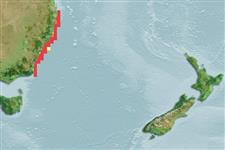
marin démersal; profondeur 45 - 300 m (Ref. 9863), usually 100 - 160 m (Ref. 9863). Temperate; 26°S - 38°S, 149°E - 154°E
Southwest Pacific: Australia, from Queensland to New South Wales. Possibly hybridizes with the largely allopatric banded stingaree Urolophus cruciatus (a more southern species), and perhaps one of the few known cases of chondrichthyan hybridization.
Longueur à la première maturité / Taille / Poids / Âge
Maturité: Lm ?, range 23 - ? cm
Max length : 42.0 cm TL mâle / non sexé; (Ref. 9863)
Little is known of its biology (Ref. 6871).
Cycle de vie et comportement reproducteur
Maturité | Reproduction | Frai | Œufs | Fécondité | Larves
Last, P.R. and J.D. Stevens, 1994. Sharks and rays of Australia. CSIRO, Australia. 513 p. (Ref. 6871)
Statut dans la liste rouge de l'IUCN (Ref. 130435: Version 2025-2 (Global))
Menace pour l'homme
Harmless
Utilisations par l'homme
Outils
Articles particuliers
Télécharger en XML
Sources Internet
Estimations basées sur des modèles
Température préférée (Réf.
123201): 14.1 - 21, mean 18.2 °C (based on 11 cells).
Indice de diversité phylogénétique (Réf.
82804): PD
50 = 0.5000 [Uniqueness, from 0.5 = low to 2.0 = high].
Bayesian length-weight: a=0.00813 (0.00371 - 0.01783), b=3.08 (2.87 - 3.29), in cm total length, based on LWR estimates for this (Sub)family-body shape (Ref.
93245).
Niveau trophique (Réf.
69278): 3.5 ±0.4 se; based on size and trophs of closest relatives
Résilience (Réf.
120179): Faible, temps minimum de doublement de population : 4,5 à 14 années (Assuming fecundity<100).
Vulnérabilité de la pêche (Ref.
59153): Low to moderate vulnerability (32 of 100).
🛈