Entorno: milieu / zona climática / rango de profundidad / gama de distribución
Ecología
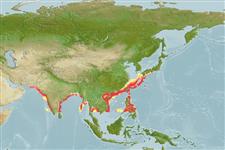
marino demersal. Subtropical; 38°N - 10°N, 62°E - 138°E (Ref. 114953)
Indo–West Pacific; Pakistan to East China Sea (Shanghai), including Taiwan and possibly Japan and Philippines.
Conservation status maybe of concern in Northwest Pacific because of its inshore benthic habitat, low abudance, and the presence of intensive demersal fisheries (Ref. 47737).
Tamaño / Peso / Edad
Madurez: Lm ? range ? - ? cm
Max length : 35.0 cm TL macho / no sexado; (Ref. 114953); common length : 30.0 cm TL macho / no sexado; (Ref. 114953)
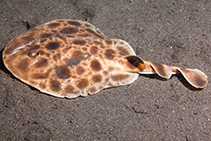
Preorbital length about equal to preoral length (and much greater than prenasal length), and dark brown spots that are usually greater than eye diameter over a brown background (Ref. 49866).
Body shape (shape guide): other.
Found in continental waters, both inshore and offshore (Ref. 9912). Biology little known (Ref. 9912). Maturity size of males at ca. 24 cm TL, birth size at ca. 11 cm TL (Ref. 114953).
Ciclo vital y comportamiento de apareamiento
Madurez | Reproducción | Puesta | Huevos | Fecundidad | Larva
de Carvalho, M.R. and J.E. Randall, 2003. Numbfishes from the Arabian Sea and surrounding gulfs, with the description of a new species from Oman (Chondrichthyes: Torpediniformes: Narcinidae). Ichthyol. Res. 50(1):59-66. (Ref. 49866)
Situación en la Lista Roja de la UICN (Ref. 130435: Version 2025-2 (Global))
Amenaza para el ser humano
Usos humanos
Herramientas
Informes especiales
Descargar XML
Fuentes de Internet
Estimaciones basadas en modelos
Temperatura preferida (Referencia
123201): 22.8 - 28.6, mean 27.1 °C (based on 1300 cells).
Índice de diversidad filogenética (Referencia
82804): PD
50 = 0.5000 [Uniqueness, from 0.5 = low to 2.0 = high].
Bayesian length-weight: a=0.01175 (0.00470 - 0.02937), b=2.88 (2.66 - 3.10), in cm total length, based on LWR estimates for this (Sub)family-body shape (Ref.
93245).
Nivel trófico (Referencia
69278): 3.1 ±0.3 se; based on size and trophs of closest relatives
Resiliencia (Referencia
120179): Bajo, población duplicada en un tiempo mínimo de 4.5-14 años (Assuming fecundity<100).
Vulnerabilidad pesquera (Ref.
59153): Low vulnerability (25 of 100).
🛈