>
Eupercaria/misc (Various families in series Eupercaria) >
Sciaenidae (Drums or croakers)
Etymology: Nibea: Greek, niba, nipsis = to wash.
Environnement : milieu / zone climatique / profondeur / gamme de distribution
Écologie
marin; eau douce; saumâtre benthopélagique. Tropical
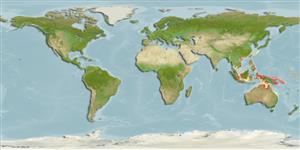
Western Central Pacific: New Guinea and northern Australia.
Taille / Poids / Âge
Maturité: Lm ? range ? - ? cm
Max length : 65.0 cm SL mâle / non sexé; (Ref. 44894); common length : 50.0 cm SL mâle / non sexé; (Ref. 9772)
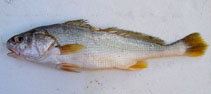
Épines dorsales (Total) : 11; Rayons mous dorsaux (Total) : 27 - 31; Épines anales: 2; Rayons mous anaux: 27 - 31. Snout blunt, obtusely rounded, slightly projecting in front of upper jaw; mouth small, inferior; upper jaw extending backward below hind margin of pupil, upper jaw length 31-38 % of head length, lower jaw length 34-40 % of head length, lower jaw length 34-40 % of head length. Mental pores in 3 pairs, the first close together, united by a crescent-shaped groove just behind symphysis. Teeth differentiated into large and small in upper jaw only; the; large ones closely spaced, not canine-like, forming outer series; a band of villiform teeth on lower jaw. Second anal spine long, stiff, 38-64 % of head length, progressively thicker with age and size. Lateral line scales numerous, 57-60. Swim bladder carrot-shaped, with about 18 pairs of fan-like appendages along its sides, the first pair entering head beyond transverse septum. Sagitta with a tadpole-shaped impression, the tail of which is J-shaped.
Body shape (shape guide): fusiform / normal.
Occurs in shallow coastal waters, estuaries and in freshwater as far as 500 km upriver from the sea (Ref. 9772, 44894).
Cycle de vie et comportement reproducteur
Maturité | Reproduction | Frai | Œufs | Fécondité | Larves
Sasaki, K., 1992. Two new species of Nibea (Sciaenidae) from northern Australia and Papua New Guinea. Jap. J. Ichthyol. 39(1):1-7. (Ref. 10324)
Statut dans la liste rouge de l'IUCN (Ref. 130435: Version 2025-2 (Global))
Menace pour l'homme
Harmless
Utilisations par l'homme
Pêcheries: commercial
Outils
Articles particuliers
Télécharger en XML
Sources Internet
Estimations basées sur des modèles
Température préférée (Réf.
123201): 26.8 - 29, mean 28.1 °C (based on 368 cells).
Indice de diversité phylogénétique (Réf.
82804): PD
50 = 0.5010 [Uniqueness, from 0.5 = low to 2.0 = high].
Bayesian length-weight: a=0.00871 (0.00427 - 0.01777), b=3.08 (2.91 - 3.25), in cm total length, based on LWR estimates for this (Sub)family-body shape (Ref.
93245).
Niveau trophique (Réf.
69278): 3.8 ±0.5 se; based on size and trophs of closest relatives
Résilience (Réf.
120179): Milieu, temps minimum de doublement de population : 1,4 à 4,4 années (Preliminary K or Fecundity.).
Vulnérabilité de la pêche (Ref.
59153): Moderate to high vulnerability (52 of 100).
🛈