Elasmobranchii (haaien en roggen) (sharks and rays) >
Myliobatiformes (Stingrays) >
Dasyatidae (Stingrays) > Urogymninae
Eponymy: Edward Gerrard (1810–1910) worked as an attendant in Gray’s department at the British Museum (1841–1896). [...] (Ref. 128868), visit book page.
More on author: Gray.
Taxonomic Remarks
Distribution to check.
Milieu: milieu / Klimaatzone / Diepte / verspreidingsgebied
Ecologie
marien; brak water demersaal; diepte ? - 50 m (Ref. 5578). Tropical
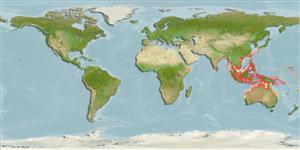
Indo-West Pacific: Oman to Indonesia; north to Taiwan.
Lengte bij maturiteit / Grootte / Gewicht / Leeftijd
Maturiteit: Lm ?, range 64 - ? cm
Max length : 200 cm TL mannelijk / geslacht onbekend; (Ref. 9840)
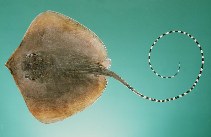
Likely confined to the inner continental shelf (Ref. 9840), over sandy and mud bottoms (Ref. 30573). Recorded from coastal waters and river mouths (Ref. 45255). Feeds on bottom crustaceans including shrimp, crabs and small lobsters (Ref. 5578). Ovoviviparous (Ref. 50449). Important food fish, the skin and flesh are dried or used to produce leather for purses and bags (Ref. 9840). Caught in very large quantities in the demersal tangle net, bottom trawl and trammel net fisheries. Utilized for its meat, skin (high value) and cartilage (Ref. 58048). It is parasitised on the dorsal skin surface by the monogeneans Dendromonocotyle citrosa, D. colorni, D. ukuthena (Ref. 124058) and D. lotteri (Ref. 124051).
Exhibit ovoviparity (aplacental viviparity), with embryos feeding initially on yolk, then receiving additional nourishment from the mother by indirect absorption of uterine fluid enriched with mucus, fat or protein through specialised structures (Ref. 50449). Distinct pairing with embrace (Ref. 205). Bears 2 young in summer (Ref. 5578). Gives birth to litters of 1-4 pups; born at 18-21 cm WD (Ref.58048).
Last, P.R., W.T. White, M.R. de Carvalho, B. Séret, M.F.W. Stehmann and G.J.P. Naylor, 2016. Rays of the world. CSIRO Publishing, Comstock Publishing Associates. i-ix + 1-790. (Ref. 114953)
Status op de Rode Lijst van het IUCN (Ref. 130435: Version 2025-2 (Global))
Gevaar voor de mens
Harmless
Gebruik door de mens
Visserij: commercieel; sportvis: ja; Aquarium: Commercieel
Tools
Speciale rapporten
Download XML
Internetbronnen
Schattingen op basis van modellen
Gewenste temperatuur (Ref.
123201): 24.7 - 29.1, mean 28.4 °C (based on 1116 cells).
Fylogenetische diversiteitsindex (Ref.
82804): PD
50 = 0.5020 [Uniqueness, from 0.5 = low to 2.0 = high].
Bayesian length-weight: a=0.01905 (0.01170 - 0.03102), b=3.08 (2.93 - 3.23), in cm total length, based on LWR estimates for this species & (Sub)family-body (Ref.
93245).
Trofisch niveau (Ref.
69278): 3.7 ±0.55 se; based on food items.
Weerstandsvermogen (Ref.
120179): Zeer laag, minimale populatieverdubbelingstijd meer dan 14 jaar (Fec=2).
Kwetsbaarheid van de visserij (Ref.
59153): Very high vulnerability (90 of 100).
🛈
Kwetsbaarheid voor het klimaat (Ref.
125649): Moderate to high vulnerability (50 of 100).
🛈
Voedingsstoffen (Ref.
124155): Calcium = 12.9 [1.9, 252.0] mg/100g; Iron = 0.63 [0.06, 7.40] mg/100g; Protein = 20.9 [18.3, 23.5] %; Omega3 = 0.122 [0.038, 0.345] g/100g; Selenium = 50.3 [10.3, 257.1] μg/100g; VitaminA = 4.98 [0.44, 49.87] μg/100g; Zinc = 0.725 [0.044, 8.176] mg/100g (wet weight);