>
Perciformes/Cottoidei (Sculpins) >
Liparidae (Snailfishes)
Etymology: Careproctus: Greek, kara = face + Greek, proktos = anus (Ref. 45335).
Eponymy: Dr Johannes Christopher Hagemann Reinhardt (1778–1845) was a Norwegian zoologist who became Professor of Zoology (1814) at the University of Copenhagen. [...] (Ref. 128868), visit book page.
Ambiente: milieu / zona climatica / distribuzione batimetrica / gamma di distribuzione
Ecologia
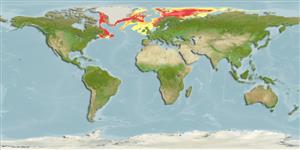
marino batidemersale; distribuzione batimetrica 75 - 1750 m (Ref. 58496). Deep-water; 81°N - 45°N, 61°W - 140°E
Arctic: Kara and Laptev seas. Atlantic: Faroe-Shetland Channel to the Norwegian Sea, Spitsbergen, Murmansk and throughout Barents Sea; one specimen from Skagerrak; Newfoundland and Labrador (Ref. 9926). Reported from Greenland (Ref. 9926) and Iceland (Ref. 12462).
Dimensione / Peso / Età
Maturità: Lm ? range ? - ? cm
Max length : 30.0 cm TL maschio/sesso non determinato; (Ref. 35388)
Breve descrizione
Chiavi di identificazione | Morfologia | Morfometria
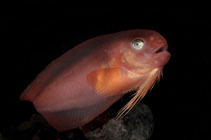
Raggi dorsali molli (totale) : 53 - 57; Raggi anali molli: 47 - 51; Vertebre: 59 - 63. Pores 2-6-7-2; post orbital pore absent, 2 suprabranchial pores, chin pores somewhat drawn together; teeth simple; lower lobe of pectoral fin longer by 1.3-2.4 times that in upper lobe; pocket-like skin fold in front of symphysis of pectoral present; anteanal distance 53%SL, pyriform disk; large gill slit reaching below the base of the lower lobe of the pectoral fin; coloration in pink present in living specimens and peritoneum without black pigmentation (Ref. 41470). Suction disc small, almost equal to diameter of the eye. One nostril on each side of the mouth (Ref. 35388).
Body shape (shape guide): elongated.
On muddy bottoms (Ref. 4702). Maximum depth reported at 1750 m )Ref. 58426). Epibenthic (Ref. 58426). Feeds on benthic and pelagic crustaceans (Ref. 4702) and fishes (Ref. 58426). Female lays about 300 eggs with a diameter of 4.5 mm (Ref. 35388).
Ciclo vitale e comportamento di accoppiamento
Maturità | Riproduzione | Deposizione | Uova | Fecondità | Larve
Nielsen, J.G. and E. Bertelsen, 1992. Fisk i grønlandske farvande. Atuakkiorfik, Nuuk. 65 s. (Ref. 9925)
Stato della Lista Rossa IUCN (Ref. 130435: Version 2025-2 (Global))
Minaccia per l'uomo
Harmless
Usi umani
Pesca: di nessun interesse
Strumenti
Rapporti speciali
Scarica XML
Fonti Internet
Stime basate su modelli
Temperatura preferita (Fonte Biblio.
123201): 0.4 - 8.6, mean 3 °C (based on 878 cells).
Indice di diversità filogenetica (Fonte Biblio.
82804): PD
50 = 0.5000 [Uniqueness, from 0.5 = low to 2.0 = high].
Bayesian length-weight: a=0.00447 (0.00203 - 0.00984), b=3.17 (2.99 - 3.35), in cm total length, based on LWR estimates for this Genus-body shape (Ref.
93245).
Livello trofico (Fonte Biblio.
69278): 3.8 ±0.58 se; based on food items.
Resilienza (Fonte Biblio.
120179): Alto, tempo minimo di raddoppiamento della popolazione meno di 15 mesi (Preliminary K or Fecundity.).
Vulnerabilità della pesca (Ref.
59153): Low vulnerability (20 of 100).
🛈