>
Clupeiformes (Herrings) >
Dorosomatidae (Gizzard shads and sardinellas)
Etymology: Congothrissa: Latin, conger = conger + Greek, thrissa, -es = shad (Ref. 45335).
Eponymy: Jean-Pierre Gosse (1924–2001) was a Belgian ichthyologist who was Curator of Vertebrates, Institut Royal des Sciences Naturelles de Belgique. [...] (Ref. 128868), visit book page.
More on author: Poll.
Environnement : milieu / zone climatique / profondeur / gamme de distribution
Écologie
; eau douce pélagique. Tropical; 7°N - 2°S
Africa: central part of Congo River system, around Kisangani in Democratic Republic of Congo and also Ubangui River at Bangui and upstream in Central African Republic (Ref. 188, 93833).
Taille / Poids / Âge
Maturité: Lm ? range ? - ? cm
Max length : 3.5 cm SL mâle / non sexé; (Ref. 188)
Description synthétique
Clés d'identification | Morphologie | Morphométrie
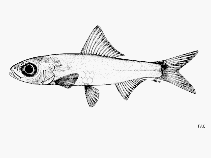
Épines dorsales (Total) : 0; Rayons mous dorsaux (Total) : 14 - 16; Épines anales: 0; Rayons mous anaux: 15 - 17. Diagnosis: Small, fairly slender fishes, depth around 22-24% of standard length; belly rounded, smooth, no trace of scutes before or behind pelvic fins; pelvic scute itself present, however, the tips of its lateral arms bifurcated; jaws about equal, with fine teeth; no second supra-maxilla; lower gillrakers 10 to 12; pelvic fin insertion just behind dorsal fin origin (Ref. 188). Scales large, 20-22 in longitudinal series (Ref. 188, 93833). Congothrissa gossei occurs with other clupeid species, but the smoothly rounded belly, absence of spiny post-pelvic scutes and lack of a second supra-maxilla makes it unmistakable (Ref. 188).
Body shape (shape guide): fusiform / normal; Cross section: compressed.
A riverine species apparently found in the main stream of the Congo River (Ref. 188). It feeds on small shrimps, mosquito larvae and chironomid larvae (Ref. 188).
Cycle de vie et comportement reproducteur
Maturité | Reproduction | Frai | Œufs | Fécondité | Larves
Whitehead, P.J.P., 1985. FAO Species Catalogue. Vol. 7. Clupeoid fishes of the world (suborder Clupeoidei). An annotated and illustrated catalogue of the herrings, sardines, pilchards, sprats, shads, anchovies and wolf-herrings. FAO Fish. Synop. 125(7/1):1-303. Rome: FAO. (Ref. 188)
Statut dans la liste rouge de l'IUCN (Ref. 130435: Version 2025-2 (Global))
Menace pour l'homme
Harmless
Utilisations par l'homme
Pêcheries: pêcheries vivrières
Outils
Articles particuliers
Télécharger en XML
Sources Internet
Estimations basées sur des modèles
Indice de diversité phylogénétique (Réf.
82804): PD
50 = 1.0000 [Uniqueness, from 0.5 = low to 2.0 = high].
Bayesian length-weight: a=0.00871 (0.00414 - 0.01834), b=3.06 (2.89 - 3.23), in cm total length, based on LWR estimates for this (Sub)family-body shape (Ref.
93245).
Niveau trophique (Réf.
69278): 3.3 ±0.47 se; based on food items.
Résilience (Réf.
120179): Haut, temps minimum de doublement de population inférieur à 15 mois (Preliminary K or Fecundity.).
Vulnérabilité de la pêche (Ref.
59153): Low vulnerability (10 of 100).
🛈