>
Clupeiformes (Herrings) >
Ehiravidae (River sprats)
Etymology: Gilchristella: Because of John Gilchrist, father of the South African ichthyology; Cape Town, 1925.
Eponymy: Dr John Dow Fisher Gilchrist (1866–1926) was a Scottish-born South African ichthyologist and naturalist. [...] Dr John Dow Fisher Gilchrist (1866–1926) was a Scottish-born South African ichthyologist and naturalist. [...] (Ref. 128868), visit book page.
Ambiente: milieu / zona climática / intervalo de profundidade / gama de distribuição
Ecologia
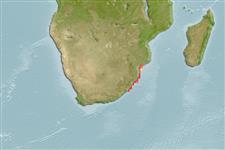
marinhas; Água doce; estuarina pelagic-neritic; anfídromo. Subtropical; 25°S - 36°S, 17°E - 34°E (Ref. 188)
Africa: Lake Piti, Mozambique, along south and east coasts of South Africa to Saldanha Bay (Ref. 188, 3509), and as far north as the Olifants River on the west coast (Ref. 7248), possibly to mouth of Orange River (Ref. 188, 3259). Also reported from Madagascar (Ref. 3509, 13333), but its presence is not confirmed; it is probably based on confusion with Sauvagella madagascariensis, while Gilchristella aestuaria does not occur in Madagascar (Ref. 33664). Reported occurrence in India (Ref. 32693) is of dubious validity (Ref. 33664). Currently a single species, but at least two forms, possibly different species, are known (Ref. 52193).
Comprimento na primeira maturidade / Tamanho / Peso / Idade
Maturidade: Lm 2.8, range 2 - 3 cm
Max length : 9.0 cm SL macho/indeterminado; (Ref. 52193); Idade máx. registada: 6 anos (Ref. 7248)
Descrição breve
Chaves de identificação | Morfologia | Morfometria
Espinhos dorsais (total) : 0; Raios dorsais moles (total) : 14 - 15; Espinhos anais: 0; Raios anais moles: 20. Diagnosis: Body rather compressed, belly rounded, with 6 to 9 thin unkeeled pre-pelvic scutes followed by an equally thin pelvic scute, all with slender ascending arms; no post-pelvic scutes; snout pointed, lower jaw a little prominent, with a single row of fine teeth in each jaw; posterior supra-maxilla paddle-shaped; gillrakers 39 to 76, gillrakers small but present on posterior face of third epibranchial; pelvic fin with i-7 finrays, under or a little before dorsal fin origin (Ref. 188). Resembles Spratelloides species or juvenile Etrumeus and Dussumieria, but pre-pelvic scutes present; other clupeids occuring in same area have keeled pre-pelvic and post-pelvic scutes (Ref. 188).
Body shape (shape guide): fusiform / normal; Cross section: oval.
Occurs in the sea, but found mostly in estuaries; also found in landlocked brackish and freshwater lagoons (Ref. 93596), also rivers and lakes (Ref. 188). Maximum size 10 cm (Ref. 4967). Entire life cycle is completed in the estuary (Ref. 32693). Breeds throughout the year with a peak in spring and early summer (Ref. 7248, 52193). Maturity may be attained within the first or second year and an age of up to 5 or 6 years is recorded (Ref. 7248, 52193). Feeds chiefly on zooplankton by filtering or selecting individual organisms from the water column (Ref. 7248, 52193). It can tolerate salinities under 4 ppt and of up to 52.6 ppt (Ref. 32693). Utilized fresh or dried and salted (Ref. 12484).
A semelparous species that grows to maturity and spawns in one year (Ref. 34361).
Skelton, P.H., 1993. A complete guide to the freshwater fishes of southern Africa. Southern Book Publishers. 388 p. (Ref. 7248)
Categoria na Lista Vermelha da IUCN (Ref. 130435: Version 2025-2 (Global))
Ameaça para o homem
Harmless
Utilização humana
Pescarias: pescarias de subsistência; isco: usually
Ferramentas
Relatórios especiais
Descarregue XML
Fontes da internet
Estimativas baseadas em modelos
Índice de diversidade filogenética (Ref.
82804): PD
50 = 1.0000 [Uniqueness, from 0.5 = low to 2.0 = high].
Bayesian length-weight: a=0.00955 (0.00468 - 0.01948), b=3.06 (2.88 - 3.24), in cm total length, based on LWR estimates for this species & (Sub)family-body (Ref.
93245).
Nível Trófico (Ref.
69278): 3.1 ±0.3 se; based on size and trophs of closest relatives
Resiliência (Ref.
120179): Elevada, tempo mínimo de duplicação da população menor que 15 meses (tm=0.5).
Vulnerabilidade da pesca (Ref.
59153): Low vulnerability (10 of 100).
🛈