This website uses cookies to enhance your browsing experience and ensure the functionality of our site. For more detailed information about the types of cookies we use and how we protect your privacy, please visit our Privacy Information page.
×
Cookie Settings
This website uses different types of cookies to enhance your experience. Please select your preferences below:
Teleostei > Clupeiformes (Herrings) > Ehiravidae (River sprats)
Etymology: Sauvagella:Because of Sauvage, 1860-1880 and 1875-1891; ichtyologist that studied the Ogowe; author of "Histoire naturelle des poissons de Madagascar"; madagascariensis:Named for the island to which it is endemic, Madagascar (Ref. 33664). Eponymy: Dr Louis César Henri Ėmile Sauvage (1842–1917) was a French palaeontologist, herpetologist and ichthyologist. [...] (Ref. 128868), visit book page. More on author: Sauvage.
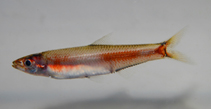
背棘 (總數) : 0; 背的軟條 (總數) : 13 - 17; 臀棘: 0; 臀鰭軟條: 17 - 19; 脊椎骨: 41 - 43. Diagnosis: Body elongate, a little compressed; belly rounded, without pre-pelvic scutes, but a pelvic scute present with slender lateral arms; gillrakers few, 17-20 gillrakers on lower limb of first arch; pelvic fin with 1 unbranched and 7 branched finrays, a little anterior to dorsal fin origin; last two anal finrays not separate from others (Ref. 188, 33664). It is distinguished from other non-scuted clupeids of Spratelloides, Dussumieria and Etrumeus by presence of a normal pelvic scute vs. W-shaped (Ref. 188). It is distinguished from Sauvagella robusta by a higher vertebral number, 41-43 vs. 38-40; a shallower body, 15.8-21.1% of standard length vs. 20.8-27.4%; a longer snout, 26.2-33.7% of head length vs. 18.5-26.6%; and a higher anal fin ray count, 17-19 vs. 13-17 (Ref. 33664).
Body shape (shape guide): fusiform / normal; Cross section: oval. 身體稍微扁長形, 腹面圓形的, 沒有前腹鰭鱗甲, 但是一個腹鰭鱗甲存在的有細長的垂直手臂。 鰓耙可能很少的。 最後兩個臀鰭棘條不分開其它 (比較 Spratellomorpha bianalis) 。 在區域 ( Spratelloides , Dussumieria, Etrumeus) 中與其他的非被鱗甲的鯡魚區分被有正常的腹鰭鱗甲 (比較 W 形的).(參考文獻 188) 體高 15.8-21.1% SL。 吻 26.2-33.7% HL.(參考文獻 33664)
Found in freshwaters, possibly tolerating brackish water (Ref. 188); from sea level to about 450m, mostly in smaller rivers and streams and usually in forested areas (Ref. 56161). Probably planktivorous (Ref. 56161).
Stiassny, M.L.J., 2002. Revision of Sauvagella Bertin (Clupeidae; Pellonulinae; Ehiravini) with a description of a new species from the freshwaters of Madagascar and diagnosis of the Ehiravini. Copeia 2002(1):67-76. (Ref. 33664)
系統發育多樣性指數 (參考文獻 82804): PD50 = 0.7500 [Uniqueness, from 0.5 = low to 2.0 = high].
Bayesian length-weight: a=0.00891 (0.00380 - 0.02091), b=3.03 (2.83 - 3.23), in cm total length, based on LWR estimates for this (Sub)family-body shape (Ref. 93245).
營養階層 (參考文獻 69278): 3.1 ±0.3 se; based on size and trophs of closest relatives
回復力 (參考文獻 120179): 高度, 族群倍增時間少於 15個月 (Preliminary K or Fecundity.).
釣魚的脆弱性 (Ref. 59153): Low vulnerability (10 of 100). 🛈