Milieu: milieu / Klimaatzone / Diepte / verspreidingsgebied
Ecologie
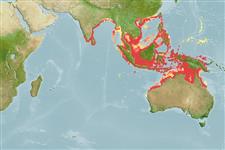
marien rifbewoner; diepte 2 - 80 m (Ref. 90102). Tropical; 24°N - 25°S, 75°E - 149°E (Ref. 55)
Western Indian Ocean: Mozambique (Ref. 41878). Indo-West Pacific: southern India and Sri Lanka to Philippines, New Guinea and Australia. Has been referred to as Lutjanus janthinuropterus and Lutjanus rangus (a junior synonym of Lutjanus bohar) by previous authors.
Grootte / Gewicht / Leeftijd
Maturiteit: Lm ? range ? - ? cm
Max length : 92.0 cm TL mannelijk / geslacht onbekend; (Ref. 132370); common length : 35.0 cm TL mannelijk / geslacht onbekend; (Ref. 55); max. gepubliceerd gewicht: 12.5 kg (Ref. 132370)
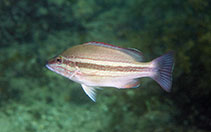
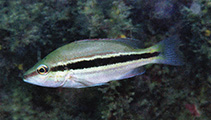
Dorsale stekels (totaal) : 10; Dorsale zachte stralen (totaal) : 13 - 14; Anale stekels: 3; Anale zachte stralen: 8. Dorsal profile of head steeply sloped, snout profile slightly concave. Preorbital bone usually much greater than eye diameter, at least in large specimens. Preopercular notch and knob poorly developed. Scale rows on back rising obliquely above lateral line. Generally gray-brown or olive on the upper portion of the back and head, grading to whitish ventrally. The dorsal and caudal fins are dusky brown or black, frequently with a narrow white posterior margin. The anal, pelvic and pectoral fins are whitish with some dusky brown. Juveniles have a broad black horizontal band from snout tip to caudal fin base. Large juveniles with black mid-lateral stripe. Adults plain pinkish brown with dusky tail (Ref. 48635). Body depth 2.5-2.8 in SL (Ref. 90102).
Body shape (shape guide): fusiform / normal; Cross section: oval.
Solitary or in small groups (Ref. 90102). Adults inhabit offshore reefs and muddy habitats. Juveniles are sometimes found in the vicinity of coral reefs, often located close to the shore where silting is moderate and visibility is reduced. Adults usually very deep (Ref. 48635). They feed on fishes and a variety of benthic invertebrates.
Levenscyclus en paargedrag
Maturiteit | Voortplanting | Paaien | Eieren | Fecunditeit | Larven
Allen, G.R., 1985. FAO Species Catalogue. Vol. 6. Snappers of the world. An annotated and illustrated catalogue of lutjanid species known to date. FAO Fish. Synop. 125(6):208 p. Rome: FAO. (Ref. 55)
Status op de Rode Lijst van het IUCN (Ref. 130435: Version 2025-2 (Global))
Gevaar voor de mens
Harmless
Gebruik door de mens
Visserij: commercieel
Tools
Speciale rapporten
Download XML
Internetbronnen
Schattingen op basis van modellen
Gewenste temperatuur (Ref.
123201): 26.3 - 29.1, mean 28.3 °C (based on 1226 cells).
Fylogenetische diversiteitsindex (Ref.
82804): PD
50 = 0.5000 [Uniqueness, from 0.5 = low to 2.0 = high].
Bayesian length-weight: a=0.01380 (0.00789 - 0.02416), b=2.97 (2.83 - 3.11), in cm total length, based on LWR estimates for this species & Genus-body shape (Ref.
93245).
Trofisch niveau (Ref.
69278): 4.0 ±0.65 se; based on food items.
Weerstandsvermogen (Ref.
120179): laag, minimale populatieverdubbelingstijd 4,5-14 jaar (Preliminary K or Fecundity.).
Kwetsbaarheid van de visserij (Ref.
59153): High vulnerability (57 of 100).
🛈
Voedingsstoffen (Ref.
124155): Calcium = 27.2 [17.9, 38.8] mg/100g; Iron = 0.301 [0.196, 0.449] mg/100g; Protein = 18.6 [17.1, 19.9] %; Omega3 = 0.129 [0.094, 0.173] g/100g; Selenium = 67.3 [46.9, 95.6] μg/100g; VitaminA = 127 [24, 444] μg/100g; Zinc = 0.403 [0.331, 0.546] mg/100g (wet weight);