>
Clupeiformes (Herrings) >
Alosidae (Shads and Sardines)
Etymology: Alosa: Latin, alausa = a fish cited by Ausonius and Latin, halec = pickle, dealing with the Greek word hals = salt; it is also the old Saxon name for shad = "alli" ; 1591 (Ref. 45335); alabamae: From the word alabamae, meaning from Alabama (Ref. 10294).
More on authors: Jordan & Evermann.
Ambiente: milieu / zona climatica / distribuzione batimetrica / gamma di distribuzione
Ecologia
marino; acqua dolce; salmastro pelagic-neritic; anadromo (Ref. 138280). Subtropical; 44°N - 24°N, 96°W - 81°W
Western Central Atlantic: Gulf of Mexico (northern part, from the Mississippi delta eastward to the Choctawhatchee River in Florida; also in rivers from Iowa to Arkansas and across to West Virginia). Status of threat from Ref. 11858.
Dimensione / Peso / Età
Maturità: Lm ? range ? - ? cm
Max length : 51.0 cm SL maschio/sesso non determinato; (Ref. 188); common length : 42.5 cm SL maschio/sesso non determinato; (Ref. 188); Età massima riportata: 4 anni (Ref. 12193)
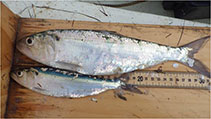
Spine dorsali (totale) : 0; Spine anali: 0. Body moderately compressed, belly with distinct keel of scutes. Lower jaw steeply rising within mouth; no teeth present at front of jaws; upper jaw with a distinct notch. The only other shad of the Gulf of Mexico has only 20 to 24 gill rakers. Closely resembles A. aestivalis and A. pseudoharengus of Atlantic coasts, but in them the lower jaw rises very steeply in the mouth (Ref. 188).
Body shape (shape guide): fusiform / normal; Cross section: compressed.
Adults form schools. They ascend rivers and streams to spawn in spring or early summer, the young presumably descending in autumn. Marketed mostly fresh.
Ciclo vitale e comportamento di accoppiamento
Maturità | Riproduzione | Deposizione | Uova | Fecondità | Larve
Spawns in freshwater in spring or early summer, ascending rivers and streams, the young presumably descending in autumn.
Whitehead, P.J.P., 1985. FAO Species Catalogue. Vol. 7. Clupeoid fishes of the world (suborder Clupeoidei). An annotated and illustrated catalogue of the herrings, sardines, pilchards, sprats, shads, anchovies and wolf-herrings. FAO Fish. Synop. 125(7/1):1-303. Rome: FAO. (Ref. 188)
Stato della Lista Rossa IUCN (Ref. 130435: Version 2025-2 (Global))
Minaccia per l'uomo
Harmless
Usi umani
Pesca: scarso interesse commerciale
Strumenti
Rapporti speciali
Scarica XML
Fonti Internet
Stime basate su modelli
Indice di diversità filogenetica (Fonte Biblio.
82804): PD
50 = 0.5000 [Uniqueness, from 0.5 = low to 2.0 = high].
Bayesian length-weight: a=0.00708 (0.00338 - 0.01484), b=3.08 (2.91 - 3.25), in cm total length, based on LWR estimates for this Genus-body shape (Ref.
93245).
Livello trofico (Fonte Biblio.
69278): 2.7 ±0.28 se; based on food items.
Resilienza (Fonte Biblio.
120179): Medio, tempo minimo di raddoppiamento della popolazione 1.4 - 4.4 anni (tmax=4).
Vulnerabilità della pesca (Ref.
59153): Moderate vulnerability (45 of 100).
🛈