>
Clupeiformes (Herrings) >
Alosidae (Shads and Sardines)
Etymology: Alosa: Latin, alausa = a fish cited by Ausonius and Latin, halec = pickle, dealing with the Greek word hals = salt; it is also the old Saxon name for shad = "alli" ; 1591 (Ref. 45335).
Eponymy: Vladimir Konstantinovich Bražnikov (or Braschnikow) (1870–1921) was a Russian zoologist, ichthyologist and entomologist with an interest in Diptera who lived in Tokyo for many years. [...] (Ref. 128868), visit book page.
More on author: Borodin.
Miljö: miljö / Klimatzon / djupintervall / distributionsområde
Ekologi
; brackvatten pelagiska; havsvandrande. Temperate; 48°N - 35°N, 45°E - 56°E (Ref. 188)
Former USSR and Asia: Caspian Sea.
Längd vid första mognad / Storlek / Vikt / Ålder
Könsmognad: Lm ?, range 20 - ? cm
Max length : 50.0 cm SL hane/ej könsbestämd; (Ref. 188); common length : 30.0 cm SL hane/ej könsbestämd; (Ref. 188)
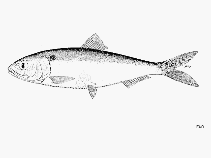
Taggstrålar i ryggfenan (totalt) : 0; Taggstrålar i analfenan: 0. Body fairly elongate, more `herring-like' than `shad-like'. gill rakers thick and coarse, shorter, equal to or a little longer than gill filaments, either straight or curved, pointed or blunt, occasionally even bifurcated at tips. Teeth well developed in both jaws. Other Caspian shads have deeper, more shad-like bodies.
Body shape (shape guide): fusiform / normal; Cross section: compressed.
Occurs in brackish water and non-anadromous, but strongly migratory. Feeds on small clupeids, gobies, atherines, also crustaceans and occasionally insects and mollusks. Spawning patterns among the subspecies vary but occur mostly in spring and summer after an inshore migration and movement northward.
Livscykel och parningsbeteende
Könsmognad | Reproduktion | Lek | Ägg | Fekunditet | Larver
Various spawning patterns among the subspecies (mostly in spring and summer after an inshore migration and movement northward).
Whitehead, P.J.P., 1985. FAO Species Catalogue. Vol. 7. Clupeoid fishes of the world (suborder Clupeoidei). An annotated and illustrated catalogue of the herrings, sardines, pilchards, sprats, shads, anchovies and wolf-herrings. FAO Fish. Synop. 125(7/1):1-303. Rome: FAO. (Ref. 188)
Status på IUCN:s rödlista (Ref. 130435: Version 2025-2 (Global))
Hot mot människor
Harmless
Mänskliga användningsområden
Fiskeri: kommersiellt viktig
Verktyg
Särskilda rapporter
Ladda ner XML
Internet-källor
Uppskattningar baserade på modeller
Index för fylogenetisk mångfald (Ref.
82804): PD
50 = 0.5000 [Uniqueness, from 0.5 = low to 2.0 = high].
Bayesian length-weight: a=0.00708 (0.00472 - 0.01062), b=3.04 (2.92 - 3.16), in cm total length, based on LWR estimates for this species & Genus-body shape (Ref.
93245).
Trofisk nivå (Ref.
69278): 3.9 ±0.4 se; based on diet studies.
Generation time: 3.1 ( na - na) years. Estimated as median ln(3)/K based on 2
growth studies.
Resiliens (Ref.
120179): Hög, lägsta populationsfördubblingstid mindre än 15 månader (Preliminary K or Fecundity.).
Sårbarhet i fisket (Ref.
59153): Low to moderate vulnerability (27 of 100).
🛈