>
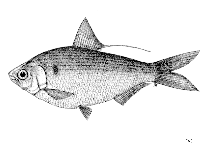
Clupeiformes (Herrings) >
Dorosomatidae (Gizzard shads and sardinellas)
Etymology: Nematalosa: Greek, nema, -atos = filament + Latin, alausa = a fish cited by Ausonius and Latin, halec = pickle, dealing with the Greek word hals = salt; it is also the old Saxon name for shad = "alli" ; 1591 (Ref. 45335).
Entorno: milieu / zona climática / rango de profundidad / gama de distribución
Ecología
marino pelagic-neritic. Tropical
Western Indian Ocean: Persian Gulf, possibly west to Somalia based on one specimen, previously identified both as Nematalosa nasus and as Nematalosa arabica.
Tamaño / Peso / Edad
Madurez: Lm ? range ? - ? cm
Max length : 17.0 cm TL macho / no sexado; (Ref. 68964)
Descripción breve
Claves de identificación | Morfología | Morfometría
Espinas dorsales (total) : 0; Espinas anales: 0. Prepectoral scutes usually 8. Expanded third infraorbital bone with the anterior end vertical or nearly so. Supraorbital grooves lacking.
Body shape (shape guide): fusiform / normal.
Pelagic. Filter feeders (Ref. 68964).
Ciclo vital y comportamiento de apareamiento
Madurez | Reproducción | Puesta | Huevos | Fecundidad | Larva
Nelson, G. and L. McCarthy, 1995. Two new species of gizzard shads of the genus Nematalosa (Teleostei, Clupeidae, Dorosomatinae) from the Persian/Arabian Gulf. Jap. J. Ichthyol. 41(4):379-383. (Ref. 9971)
Situación en la Lista Roja de la UICN (Ref. 130435: Version 2025-2 (Global))
Amenaza para el ser humano
Harmless
Usos humanos
Herramientas
Informes especiales
Descargar XML
Fuentes de Internet
Estimaciones basadas en modelos
Índice de diversidad filogenética (Referencia
82804): PD
50 = 0.5005 [Uniqueness, from 0.5 = low to 2.0 = high].
Bayesian length-weight: a=0.00871 (0.00414 - 0.01834), b=3.06 (2.89 - 3.23), in cm total length, based on LWR estimates for this (Sub)family-body shape (Ref.
93245).
Nivel trófico (Referencia
69278): 3.3 ±0.4 se; based on size and trophs of closest relatives
Resiliencia (Referencia
120179): Alto, población duplicada en un tiempo mínimo inferior a 15 meses (Preliminary K or Fecundity.).
Vulnerabilidad pesquera (Ref.
59153): Low vulnerability (10 of 100).
🛈