>
Clupeiformes (Herrings) >
Alosidae (Shads and Sardines)
Etymology: Alosa: Latin, alausa = a fish cited by Ausonius and Latin, halec = pickle, dealing with the Greek word hals = salt; it is also the old Saxon name for shad = "alli" ; 1591 (Ref. 45335).
Eponymy: Alexandre Alexandrovich Sapozhnikov (1827–1887) ran Sapozhnikov Brothers, the oldest fishery company (1796) in Astrakhan The family was renowned for its benevolence including funding, opening and running an orphanage at the time of a cholera [...] (Ref. 128868), visit book page.
Milieu: milieu / Klimaatzone / Diepte / verspreidingsgebied
Ecologie
; zoet water; brak water pelagisch; potamodroom (Ref. 51243). Temperate; 3°C - 25°C (Ref. 56460); 49°N - 35°N, 44°E - 56°E (Ref. 188)
Europe and Central Asia: Caspian Sea.
Grootte / Gewicht / Leeftijd
Maturiteit: Lm ? range ? - ? cm
Max length : 38.1 cm TL mannelijk / geslacht onbekend; (Ref. 111344); common length : 21.0 cm SL mannelijk / geslacht onbekend; (Ref. 188); max. gepubliceerd gewicht: 469.00 g (Ref. 56460); max. gerapporteerde leeftijd: 9 Jaren (Ref. 56460)
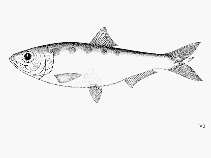
Dorsale stekels (totaal) : 0; Anale stekels: 0. Body `shad-like'; upper and lower head profiles straight. Gill rakers moderately thick and short, tips pointed, usually shorter than gill filaments. Teeth well developed in both jaws. Resembles A. sphaerocephala, which has a blunter head, with round upper and lower head profiles; A. caspia has more gill rakers (50 to 180) and A. brashnikovi is more slender and `herring-like'.
Body shape (shape guide): fusiform / normal; Cross section: compressed.
Euryhaline and migratory but non-anadromous. One of the most cold-loving Alosa of the Caspian (among the first to migrate in spring to the north). Feeds on large crustaceans and small fishes. Spawns in northern Caspian from end of April (peak in mid-May), moving into shallow water and spawning at depths of 1-6 m and salinities of 0.07-11 ppt. The young later move southward; some perhaps remain in the north.
Levenscyclus en paargedrag
Maturiteit | Voortplanting | Paaien | Eieren | Fecunditeit | Larven
Whitehead, P.J.P., 1985. FAO Species Catalogue. Vol. 7. Clupeoid fishes of the world (suborder Clupeoidei). An annotated and illustrated catalogue of the herrings, sardines, pilchards, sprats, shads, anchovies and wolf-herrings. FAO Fish. Synop. 125(7/1):1-303. Rome: FAO. (Ref. 188)
Status op de Rode Lijst van het IUCN (Ref. 130435: Version 2025-2 (Global))
Gevaar voor de mens
Harmless
Gebruik door de mens
Visserij: van minder commercieel belang
Tools
Speciale rapporten
Download XML
Internetbronnen
Schattingen op basis van modellen
Fylogenetische diversiteitsindex (Ref.
82804): PD
50 = 0.5000 [Uniqueness, from 0.5 = low to 2.0 = high].
Bayesian length-weight: a=0.00724 (0.00468 - 0.01121), b=3.14 (3.02 - 3.26), in cm total length, based on LWR estimates for this species & Genus-body shape (Ref.
93245).
Trofisch niveau (Ref.
69278): 4.4 ±0.0 se; based on diet studies.
Generation time: 3.1 ( na - na) years. Estimated as median ln(3)/K based on 1
growth studies.
Weerstandsvermogen (Ref.
120179): Gemiddeld, minimale populatieverdubbelingstijd 1,4-4,4 jaar (K=0.3).
Kwetsbaarheid van de visserij (Ref.
59153): Low to moderate vulnerability (33 of 100).
🛈