>
Beloniformes (Needle fishes) >
Zenarchopteridae (Internally fertilized halfbeaks)
Etymology: Hemirhamphodon: Greek, hemi = half + Greek, rhamphos = bill + greek, odous = teeth (Ref. 45335).
More on author: Bleeker.
Entorno: milieu / zona climática / rango de profundidad / gama de distribución
Ecología
; agua dulce pelágico; rango de profundidad 0 - ? m. Tropical
Asia: Bangka, Belitung, Borneo and Sumatra, Indonesia.
Tamaño / Peso / Edad
Madurez: Lm ? range ? - ? cm
Max length : 5.3 cm SL macho / no sexado; (Ref. 7050)
Descripción breve
Claves de identificación | Morfología | Morfometría
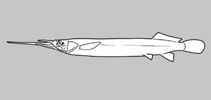
Differs from other species in the genus by many dorsal-fin rays, 21-25 versus 1220 and anal fin origin under dorsal-fin ray number 13-16 compared to 4-11. Dorsal fin origin anterior to origin of pelvic fin; posterior to pelvic fin origin in other species (Ref. 26761).
In rivers. Females bear live young (Ref. 58777).
Ciclo vital y comportamiento de apareamiento
Madurez | Reproducción | Puesta | Huevos | Fecundidad | Larva
Anderson, W.D. III and B.B. Collette, 1991. Revision of the freshwater viviparous halfbeaks of the genus Hemirhamphodon (Teleostei: Hemiramphidae). Ichthyol. Explor. Freshwat. 2(2):151-176. (Ref. 26761)
Situación en la Lista Roja de la UICN (Ref. 130435: Version 2025-2 (Global))
Amenaza para el ser humano
Harmless
Usos humanos
Herramientas
Informes especiales
Descargar XML
Fuentes de Internet
Estimaciones basadas en modelos
Índice de diversidad filogenética (Referencia
82804): PD
50 = 0.5020 [Uniqueness, from 0.5 = low to 2.0 = high].
Bayesian length-weight: a=0.00457 (0.00198 - 0.01053), b=3.03 (2.83 - 3.23), in cm total length, based on LWR estimates for this (Sub)family-body shape (Ref.
93245).
Nivel trófico (Referencia
69278): 3.1 ±0.4 se; based on size and trophs of closest relatives
Vulnerabilidad pesquera (Ref.
59153): Low vulnerability (10 of 100).
🛈