>
Clupeiformes (Herrings) >
Clupeidae (Herrings, shads, sardines, menhadens)
Etymology: Ethmidium: Diminutive of Greek, ethmos, -ou = sieve or ethmoides bone (Ref. 45335).
More on author: Valenciennes.
Entorno: milieu / zona climática / rango de profundidad / gama de distribución
Ecología
marino pelagic-neritic; rango de profundidad 0 - 50 m (Ref. 188).
Deprecated: strtoupper(): Passing null to parameter #1 ($string) of type string is deprecated in /var/www/html/includes/speciessummary.lib.php on line 1589
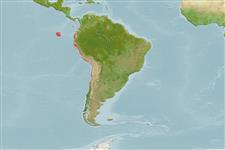
Tropical; 0° - 37°S, 86°W - 70°W (Ref. 188)
Southwest Pacific: Peru (Puerto Pizarro in Gulf of Guayaquil to Callao and Pisco Bay; presumably to border with Chile, but no records) and Chile (whole coast south to Talcahuano).
Longitud en la primera madurez / Tamaño / Peso / Edad
Madurez: Lm 25.4 range ? - ? cm
Max length : 31.2 cm TL macho / no sexado; (Ref. 122662)
Descripción breve
Claves de identificación | Morfología | Morfometría
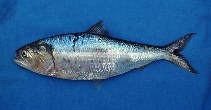
Espinas dorsales (total) : 0; Espinas anales: 0; Radios blandos anales: 12 - 15. Scutes present along back (before dorsal fin) as well as along belly. Upper jaw with median notch. Gill rakers fine and slender, about 130 to 150 in lower limb. Anal fin short, well behind last dorsal fin ray. Scales with pectinated hind border. A dark spot behind gill cover and up to 4 series of vertically oval spots along flank.
Body shape (shape guide): fusiform / normal; Cross section: compressed.
Occurs in coastal waters, forming large schools. Feeds by filtering phytoplankton (diatoms) and zooplankton (especially copepods), but will also take small fishes and crustaceans. Breeds in spring (Chile), depositing its eggs in coastal waters on sand, to which the sticky eggs cling, the larvae rising and joining the surface plankton on hatching. Marketed fresh, frozen, or canned.
Whitehead, P.J.P., 1985. FAO Species Catalogue. Vol. 7. Clupeoid fishes of the world (suborder Clupeoidei). An annotated and illustrated catalogue of the herrings, sardines, pilchards, sprats, shads, anchovies and wolf-herrings. FAO Fish. Synop. 125(7/1):1-303. Rome: FAO. (Ref. 188)
Situación en la Lista Roja de la UICN (Ref. 130435: Version 2025-2 (Global))
Amenaza para el ser humano
Harmless
Usos humanos
Pesquerías: comercial
Herramientas
Informes especiales
Descargar XML
Fuentes de Internet
Estimaciones basadas en modelos
Temperatura preferida (Referencia
123201): 11.3 - 23, mean 20 °C (based on 12 cells).
Índice de diversidad filogenética (Referencia
82804): PD
50 = 1.0000 [Uniqueness, from 0.5 = low to 2.0 = high].
Bayesian length-weight: a=0.00692 (0.00417 - 0.01147), b=3.15 (3.00 - 3.30), in cm total length, based on LWR estimates for this species & (Sub)family-body (Ref.
93245).
Nivel trófico (Referencia
69278): 2.1 ±0.0 se; based on diet studies.
Resiliencia (Referencia
120179): Alto, población duplicada en un tiempo mínimo inferior a 15 meses (Assuming tm=1).
Vulnerabilidad pesquera (Ref.
59153): Low vulnerability (21 of 100).
🛈
Vulnerabilidad climática (Ref.
125649): High vulnerability (58 of 100).
🛈
Nutrientes (Ref.
124155): Calcium = 205 [96, 359] mg/100g; Iron = 1.78 [0.96, 3.23] mg/100g; Protein = 18.5 [17.2, 19.7] %; Omega3 = 0.328 [0.181, 0.617] g/100g; Selenium = 49.3 [23.6, 108.2] μg/100g; VitaminA = 15.7 [4.7, 49.2] μg/100g; Zinc = 1.78 [1.21, 2.65] mg/100g (wet weight);