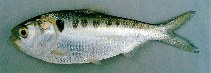
>
Clupeiformes (Herrings) >
Dorosomatidae (Gizzard shads and sardinellas)
Etymology: Tenualosa: Latin, tenuis = thin + Latin, alausa = a fish cited by Ausonius and Latin, halec = pickle, dealing with the Greek word hals = salt; it is also the old Saxon name for shad = "alli" ; 1591 (Ref. 45335).
Eponymy: Leon Emmanuel Thibaudeau (1883–1946) was a French Colonial administrator (1907– 1942) who became Résident Supérieur, Cambodia. [...] (Ref. 128868), visit book page.
Ambiente: milieu / zona climatica / distribuzione batimetrica / gamma di distribuzione
Ecologia
; acqua dolce pelagico; potamodromo (Ref. 138296). Tropical; 20°N - 10°N
Asia: Mekong River system.
Dimensione / Peso / Età
Maturità: Lm ? range ? - ? cm
Max length : 30.0 cm SL maschio/sesso non determinato; (Ref. 30857); peso massimo pubblicato: 1.0 kg (Ref. 9497)
Breve descrizione
Chiavi di identificazione | Morfologia | Morfometria
Spine dorsali (totale) : 0; Spine anali: 0. Deep body (Ref. 43281). Belly with 28 to 30 scutes. Head large; a median notch in upper jaw which distinguishes it from other similar clupeids, except Hilsa kelee. gill rakers fine and numerous, 204 to 316 on lower part of arch (increasing with size of fish); with mucosal buds and not asperities on upper edges of rakers. Caudal fin moderate. A dark spot behind gill opening; a series of spots along flank (Ref. 188).
Body shape (shape guide): fusiform / normal; Cross section: compressed.
Inhabits mainstreams, lowland tributaries and floodplains (Ref. 58784). A riverine species, at least judging from the distance (as far as 2000 km from sea) up the Mekong River. A filter feeder specializing in microscopic food such as phytoplankton or bacteria found on particulate matter (Ref. 12693) and zooplankton (Ref. 58784). A ripe male was recorded at Nongkai, Thailand. Migrate up the Mekong River at Chinese New Year (late January to late February) in company with Cirrhinus spp. and Botia modesta and downstream in June-July with Cirrhinus spp. Most large spawning fish of 400-500 g weight. Last recorded large scale migrations was in 1984 and is likely to disappear (Ref. 9497). Largest individuals are found in the Great Lake and smaller ones in northern Cambodia (Ref. 12693). In the middle Mekong along the Thai-Lao border, small individuals (young of the year) of 4 to 5 cm TL were first encountered in the middle of April, which by the middle of May had doubled in average size. By early June, the average individuals taken in haul seines had a total length of 14 cm, although the consistent recruitment of smaller individuals half that size indicated that spawning period may have extended over more than one month. The abundance of young of the year increases during the onset of the rising water levels when the suspended solids increase. This species migrates downstream into Cambodia in July. It may follow the turbid floodwaters all the way to the Tonlé Sap, perhaps moving into the Great Lake as it fills with water from the Mekong. As water levels in the Great Lake fall, it migrates back down the Tonlé Sap to the Mekong. With water flow decreasing, it begins the movement upstream toward Khoné Falls. Whether or not an individual fish would cover this entire distance is unknown, as is the time required for such journey (Ref. 12693). Above the Khone Falls, a combination of the first rain, increased water levels and increased turbidity triggers the fish to undertake upstream migration to spawning sites associated with flooded areas in tributaries of the Mekong. As water starts to recede, it moves back to the mainstream (Ref. 37770). Its numbers seem to decline drastically for unknown reason, although it may be due to multiple factors including dam construction and over-fishing. The decline over the two decades may be due to the traps used at Khoné Falls. However, the previous government in Laos declared the traps illegal in 1968 and destroyed them, allowing fishing only by net and hook-and-line (Ref. 9497). Fishing improved all along the middle Mekong from Pakse to Vientiane following the destruction of the traps (Ref. 39350).
Ciclo vitale e comportamento di accoppiamento
Maturità | Riproduzione | Deposizione | Uova | Fecondità | Larve
Whitehead, P.J.P., 1985. FAO Species Catalogue. Vol. 7. Clupeoid fishes of the world (suborder Clupeoidei). An annotated and illustrated catalogue of the herrings, sardines, pilchards, sprats, shads, anchovies and wolf-herrings. FAO Fish. Synop. 125(7/1):1-303. Rome: FAO. (Ref. 188)
Stato della Lista Rossa IUCN (Ref. 130435: Version 2025-2 (Global))
Minaccia per l'uomo
Harmless
Usi umani
Pesca: scarso interesse commerciale
Strumenti
Rapporti speciali
Scarica XML
Fonti Internet
Stime basate su modelli
Indice di diversità filogenetica (Fonte Biblio.
82804): PD
50 = 0.5312 [Uniqueness, from 0.5 = low to 2.0 = high].
Bayesian length-weight: a=0.00871 (0.00414 - 0.01834), b=3.06 (2.89 - 3.23), in cm total length, based on LWR estimates for this (Sub)family-body shape (Ref.
93245).
Livello trofico (Fonte Biblio.
69278): 2.0 ±0.00 se; based on food items.
Resilienza (Fonte Biblio.
120179): Alto, tempo minimo di raddoppiamento della popolazione meno di 15 mesi (Assuming fec > 10,000).
Vulnerabilità della pesca (Ref.
59153): Low to moderate vulnerability (27 of 100).
🛈