>
Clupeiformes (Herrings) >
Dorosomatidae (Gizzard shads and sardinellas)
Etymology: Nematalosa: Greek, nema, -atos = filament + Latin, alausa = a fish cited by Ausonius and Latin, halec = pickle, dealing with the Greek word hals = salt; it is also the old Saxon name for shad = "alli" ; 1591 (Ref. 45335).
Eponymy: ‘HMS Erebus’ was a British warship used in surveying and exploring and from which the holotype was collected. (Ref. 128868), visit book page.
More on author: Günther.
Ambiente: milieu / zona climática / intervalo de profundidade / gama de distribuição
Ecologia
; Água doce; estuarina pelágico(a,os,as); potamódromo (Ref. 51243); intervalo de profundidade 0 - 3 m (Ref. 6390). Subtropical; 15°C - 25°C (Ref. 2060); 11°S - 37°S
Oceania and Asia: Rivers of Australia and southwestern Papua New Guinea (from Fortescue River near Dampier Archipelago in Western Australia, eastward in rivers through the Northern Territory and Queensland south to the Murray-Darling system; also the Finke River, affluent to Lake Eyre; Bensbach River (Ref. 6993) and Digoel River in New Guinea.
Comprimento na primeira maturidade / Tamanho / Peso / Idade
Maturidade: Lm 18.3, range 13 - ? cm
Max length : 48.0 cm SL macho/indeterminado; (Ref. 6390)
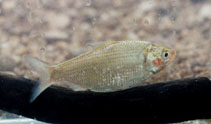
Espinhos dorsais (total) : 0; Espinhos anais: 0; Raios anais moles: 17 - 26. Belly with 14 to 18 (usually 16 to 17) - 11 to 14 (usually 12 or 13), total 25 to 31 (usually 20 to 30) scutes. Anterior arm of pre-operculum with fleshy triangular area above, not covered by third infra-orbital bone (see N. come). Edge of lower jaw strongly flared outward. Pectoral axillary scale rudimentary or absent. Hind edge of scales not toothed. A dark spot behind gill opening.
Body shape (shape guide): fusiform / normal; Cross section: compressed.
Occur often far up rivers, but also in estuaries and in Lakes Alexandrina and Albert near mouth of a river (Ref. 188). Most commonly inhabit streams coursing through relatively dry eucalyptus-scrub or desert areas, preferring sluggish or quiet waters (Ref. 5259, 44894). Also found in saline lakes (slightly less salty than sea water). Tolerant of water temperatures between 9° and 38°C and pH 4.8-8.6. Although these fish have a wide tolerance of temperature and pH, they are susceptible to oxygen depletion and are usually the first to perish when ephemeral habitats begin to dry up. Common length is 15-20 cm (Ref. 44894). Frequently noted in large shoals that feed on benthic algae; also feed on insects and small crustaceans. Spawning may occur repeatedly in the north with a peak during the wet season; probably annual in the south (Ref. 5259, 44894).
In more northerly part of its range, spawning may take place several times over the year but is probably annual in southern localities.
Whitehead, P.J.P., 1985. FAO Species Catalogue. Vol. 7. Clupeoid fishes of the world (suborder Clupeoidei). An annotated and illustrated catalogue of the herrings, sardines, pilchards, sprats, shads, anchovies and wolf-herrings. FAO Fish. Synop. 125(7/1):1-303. Rome: FAO. (Ref. 188)
Categoria na Lista Vermelha da IUCN (Ref. 130435: Version 2025-2 (Global))
Utilização humana
Pescarias: espécies comerciais; isco: usually
Ferramentas
Relatórios especiais
Descarregue XML
Fontes da internet
Estimativas baseadas em modelos
Índice de diversidade filogenética (Ref.
82804): PD
50 = 0.5005 [Uniqueness, from 0.5 = low to 2.0 = high].
Bayesian length-weight: a=0.00708 (0.00406 - 0.01233), b=2.99 (2.84 - 3.14), in cm total length, based on LWR estimates for this species & (Sub)family-body (Ref.
93245).
Nível Trófico (Ref.
69278): 2.8 ±0.29 se; based on food items.
Generation time: 4.1 ( na - na) years. Estimated as median ln(3)/K based on 2
growth studies.
Resiliência (Ref.
120179): Médio, tempo mínimo de duplicação da população 1,4 - 4,4 anos (tm=2; tmax=10; Fec=33,000).
Vulnerabilidade da pesca (Ref.
59153): Moderate vulnerability (36 of 100).
🛈