>
Clupeiformes (Herrings) >
Dorosomatidae (Gizzard shads and sardinellas)
Etymology: Nematalosa: Greek, nema, -atos = filament + Latin, alausa = a fish cited by Ausonius and Latin, halec = pickle, dealing with the Greek word hals = salt; it is also the old Saxon name for shad = "alli" ; 1591 (Ref. 45335).
More on author: Regan.
Entorno: milieu / zona climática / rango de profundidad / gama de distribución
Ecología
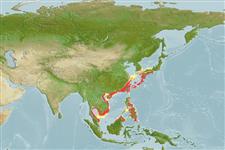
marino bentopelágico. Tropical; 37°N - 4°N, 98°E - 136°E (Ref. 188)
Western Pacific: Matsushima Bay, Sea of Japan southward to Taiwan Island, Hong Kong, the Philippines, and a single record from Gulf of Thailand.
Tamaño / Peso / Edad
Madurez: Lm ? range ? - ? cm
Max length : 19.0 cm SL macho / no sexado; (Ref. 188)
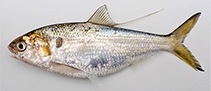
Espinas dorsales (total) : 0; Espinas anales: 0; Radios blandos anales: 17 - 26. Body generally more slender than in other species, belly with total 30 to 34 scutes. Anterior arm of pre-operculum with a fleshy triangle above, not covered by third infra-orbital bone (see N. come). Lower jaw strongly flared outward. Pectoral axillary scale well developed. Hind edge of scales distinctly toothed. A dark spot behind gill opening.
Body shape (shape guide): fusiform / normal; Cross section: compressed.
Schooling near shore over sand or mud, preferring warmer water than Konosirus punctatus. A filter-feeder; takes minute algae or organic matter. Breeds around May in Japanese waters.
Ciclo vital y comportamiento de apareamiento
Madurez | Reproducción | Puesta | Huevos | Fecundidad | Larva
Whitehead, P.J.P., 1985. FAO Species Catalogue. Vol. 7. Clupeoid fishes of the world (suborder Clupeoidei). An annotated and illustrated catalogue of the herrings, sardines, pilchards, sprats, shads, anchovies and wolf-herrings. FAO Fish. Synop. 125(7/1):1-303. Rome: FAO. (Ref. 188)
Situación en la Lista Roja de la UICN (Ref. 130435: Version 2025-2 (Global))
Amenaza para el ser humano
Harmless
Usos humanos
Pesquerías: escaso valor comercial
Herramientas
Informes especiales
Descargar XML
Fuentes de Internet
Estimaciones basadas en modelos
Temperatura preferida (Referencia
123201): 20.7 - 29, mean 27.4 °C (based on 340 cells).
Índice de diversidad filogenética (Referencia
82804): PD
50 = 0.5005 [Uniqueness, from 0.5 = low to 2.0 = high].
Bayesian length-weight: a=0.00871 (0.00414 - 0.01834), b=3.06 (2.89 - 3.23), in cm total length, based on LWR estimates for this (Sub)family-body shape (Ref.
93245).
Nivel trófico (Referencia
69278): 2.4 ±0.16 se; based on food items.
Resiliencia (Referencia
120179): Alto, población duplicada en un tiempo mínimo inferior a 15 meses (Preliminary K or Fecundity.).
Vulnerabilidad pesquera (Ref.
59153): Low vulnerability (13 of 100).
🛈