>
Clupeiformes (Herrings) >
Dorosomatidae (Gizzard shads and sardinellas)
Etymology: Nematalosa: Greek, nema, -atos = filament + Latin, alausa = a fish cited by Ausonius and Latin, halec = pickle, dealing with the Greek word hals = salt; it is also the old Saxon name for shad = "alli" ; 1591 (Ref. 45335).
Eponymy: Marcus Élieser Bloch (1723–1799) was a German physician and naturalist specialising in ichthyology. [...] (Ref. 128868), visit book page.
More on author: Bloch.
Milieu: milieu / Klimaatzone / Diepte / verspreidingsgebied
Ecologie
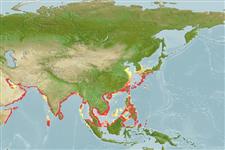
marien; zoet water; brak water pelagic-neritic; anadroom (Ref. 51243); diepte 0 - 30 m (Ref. 6898). Tropical; 38°N - 1°N, 47°E - 136°E (Ref. 188)
Indo-West Pacific: Gulf of Aden north to the Persian Gulf, then eastward to the Andaman Sea, South China Sea and the Philippines, and north to southern tip of Korea. Also reported from Durban Bay in South Africa based on a single juvenile (Ref. 3259).
Lengte bij maturiteit / Grootte / Gewicht / Leeftijd
Maturiteit: Lm 16.2 range ? - ? cm
Max length : 27.2 cm TL mannelijk / geslacht onbekend; (Ref. 122095); common length : 15.0 cm SL mannelijk / geslacht onbekend; (Ref. 188)
Dorsale stekels (totaal) : 0; Dorsale zachte stralen (totaal) : 15 - 19; Anale stekels: 0; Anale zachte stralen: 21 - 25. Diagnosis: Body rather deep, its depth about 34-41% of standard length, belly with 17-20 + 9-13 scutes, total 28-32 scutes; anterior arm of pre-operculum with the third infra-orbital bone immediately above it, no fleshy gap between; mouth inferior, lower jaw strongly flared outward; last dorsal finray filamentous; pectoral axillary scale present; hind edge of scales distinctly toothed; a dark spot behind gill opening (Ref. 188). Resembles Nematalosa galatheae, which has spots along the flank and a smooth hind edge to scales; Nematalosa arabica, N. come and N. japonica all have a distinct fleshy triangular area above the anterior arm of the pre-operculum and none have toothed scale edges; no other clupeid in the distribution area of Nematalosa nasus has a filamentous dorsal finray (Ref. 188).
Body shape (shape guide): fusiform / normal; Cross section: compressed.
Known from estuaries and coastal areas, occasionally ascending into the upper reaches of the tidal zone (Ref. 12693). A filter-feeder. Marketed fresh, dried-salted or boiled. Made into fish balls. Very bony.
Whitehead, P.J.P., 1985. FAO Species Catalogue. Vol. 7. Clupeoid fishes of the world (suborder Clupeoidei). An annotated and illustrated catalogue of the herrings, sardines, pilchards, sprats, shads, anchovies and wolf-herrings. FAO Fish. Synop. 125(7/1):1-303. Rome: FAO. (Ref. 188)
Status op de Rode Lijst van het IUCN (Ref. 130435: Version 2025-2 (Global))
Gevaar voor de mens
Harmless
Gebruik door de mens
Visserij: van minder commercieel belang
Tools
Speciale rapporten
Download XML
Internetbronnen
Schattingen op basis van modellen
Gewenste temperatuur (Ref.
123201): 25.2 - 29.2, mean 28.6 °C (based on 1229 cells).
Fylogenetische diversiteitsindex (Ref.
82804): PD
50 = 0.5005 [Uniqueness, from 0.5 = low to 2.0 = high].
Bayesian length-weight: a=0.00851 (0.00750 - 0.00965), b=3.05 (3.01 - 3.09), in cm total length, based on LWR estimates for this species (Ref.
93245).
Trofisch niveau (Ref.
69278): 2.2 ±0.09 se; based on food items.
Generation time: 1.2 ( na - na) years. Estimated as median ln(3)/K based on 1
growth studies.
Weerstandsvermogen (Ref.
120179): Hoog, minimale populatieverdubbelingstijd minder dan 15 maanden (Preliminary K or Fecundity.).
Prior r = 1.13, 95% CL = 0.74 - 1.69, Based on 2 data-limited stock assessments.
Kwetsbaarheid van de visserij (Ref.
59153): Low vulnerability (18 of 100).
🛈
Kwetsbaarheid voor het klimaat (Ref.
125649): Low vulnerability (16 of 100).
🛈
Voedingsstoffen (Ref.
124155): Calcium = 235 [125, 406] mg/100g; Iron = 1.85 [1.05, 3.13] mg/100g; Protein = 18.8 [17.6, 19.9] %; Omega3 = 0.356 [0.203, 0.646] g/100g; Selenium = 40.2 [19.5, 82.2] μg/100g; VitaminA = 16.5 [6.1, 40.6] μg/100g; Zinc = 2.19 [1.54, 3.23] mg/100g (wet weight);