>
Clupeiformes (Herrings) >
Dorosomatidae (Gizzard shads and sardinellas)
Etymology: Anodontostoma: Greek, ana = up + Greek, odous = teeth + Greek, stoma = mouth (Ref. 45335).
More on author: Hamilton.
Miljö: miljö / Klimatzon / djupintervall / distributionsområde
Ekologi
marina; sötvatten; brackvatten pelagic-neritic; anadrom (Ref. 51243); djupintervall 0 - 50 m (Ref. 188). Tropical; 31°N - 23°S, 47°E - 171°E (Ref. 188)
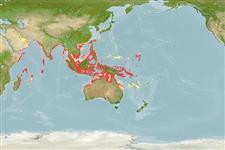
Indo-West Pacific: Persian Gulf to coasts of India and Andaman Sea, to Gulf of Thailand, Indonesia, Viet Nam, and Philippines, south to northern Australia, the Caroline Islands and New Caledonia.
Längd vid första mognad / Storlek / Vikt / Ålder
Könsmognad: Lm 14.1 range ? - ? cm
Max length : 22.0 cm SL hane/ej könsbestämd; (Ref. 54980); common length : 14.0 cm SL hane/ej könsbestämd; (Ref. 3107)
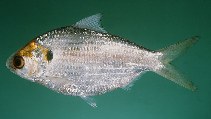
Taggstrålar i ryggfenan (totalt) : 0; Taggstrålar i analfenan: 0; Mjukstrålar i analfenan: 17 - 25. Body depth increasing with size of fish, 40 to 70 % standard length in fishes over 10 cm. Second supra-maxilla a mere splint. Longest gill rakers on lower part of arch less than corresponding gill filaments. Hind edges of scales toothed, the teeth thinner than the gaps between them; a median series of pre-dorsal scales. A large black spot behind gill opening.
Body shape (shape guide): fusiform / normal; Cross section: compressed.
Pelagic inshore (Ref. 68964). Usually marine coastal, but ascends rivers to the upper tidal zone (Ref. 12693). Occurs inshore and also in estuaries. Feeds on diatoms, radiolarians, mollusks, copepods, and crustaceans (in that order of importance, at least in the Godavari estuary). Breeds from November to February, mainly in the later part (Godavari estuary). Marketed fresh, frozen, dried, dried-salted or boiled. Made into fish balls.
Whitehead, P.J.P., 1985. FAO Species Catalogue. Vol. 7. Clupeoid fishes of the world (suborder Clupeoidei). An annotated and illustrated catalogue of the herrings, sardines, pilchards, sprats, shads, anchovies and wolf-herrings. FAO Fish. Synop. 125(7/1):1-303. Rome: FAO. (Ref. 188)
Status på IUCN:s rödlista (Ref. 130435: Version 2025-2 (Global))
Hot mot människor
Harmless
Mänskliga användningsområden
Fiskeri: kommersiell
Verktyg
Särskilda rapporter
Ladda ner XML
Internet-källor
Uppskattningar baserade på modeller
Önskad temperatur (Ref.
123201): 26.5 - 29.1, mean 28.3 °C (based on 1250 cells).
Index för fylogenetisk mångfald (Ref.
82804): PD
50 = 0.6250 [Uniqueness, from 0.5 = low to 2.0 = high].
Bayesian length-weight: a=0.00871 (0.00763 - 0.00995), b=3.05 (3.01 - 3.09), in cm total length, based on LWR estimates for this species (Ref.
93245).
Trofisk nivå (Ref.
69278): 2.8 ±0.28 se; based on food items.
Generation time: 1.3 ( na - na) years. Estimated as median ln(3)/K based on 2
growth studies.
Resiliens (Ref.
120179): Hög, lägsta populationsfördubblingstid mindre än 15 månader (K=0.9-1.3).
Prior r = 1.19, 95% CL = 0.79 - 1.79, Based on 4 data-limited stock assessments.
Sårbarhet i fisket (Ref.
59153): Low vulnerability (14 of 100).
🛈
Sårbarhet för klimatet (Ref.
125649): Moderate to high vulnerability (51 of 100).
🛈
Näringsämnen (Ref.
124155): Calcium = 282 [162, 519] mg/100g; Iron = 2.3 [1.3, 3.8] mg/100g; Protein = 19 [18, 20] %; Omega3 = 0.416 [0.233, 0.743] g/100g; Selenium = 53.1 [26.1, 110.1] μg/100g; VitaminA = 12.1 [4.9, 28.2] μg/100g; Zinc = 2.17 [1.53, 3.17] mg/100g (wet weight);