>
Clupeiformes (Herrings) >
Dorosomatidae (Gizzard shads and sardinellas)
Etymology: Anodontostoma: Greek, ana = up + Greek, odous = teeth + Greek, stoma = mouth (Ref. 45335).
Environnement : milieu / zone climatique / profondeur / gamme de distribution
Écologie
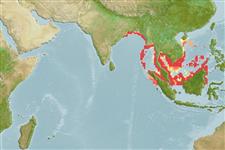
marin; saumâtre pelagic-neritic; anadrome (Ref. 51243); profondeur 0 - 50 m (Ref. 188). Tropical; 24°N - 0°N, 85°E - 119°E (Ref. 188)
Indo-Pacific: Indian Ocean (northern part of Bay of Bengal, Andaman Sea at Phuket in Thailand), Gulf of Thailand, South China Sea. Also found in Indonesia (Ref. 7050). In earlier works, Anodontostoma chacunda was often misapplied to Anodontostoma thailandiae.
Taille / Poids / Âge
Maturité: Lm ? range ? - ? cm
Max length : 18.0 cm SL mâle / non sexé; (Ref. 188); common length : 12.0 cm SL mâle / non sexé; (Ref. 188)
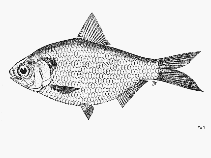
Épines dorsales (Total) : 0; Épines anales: 0; Rayons mous anaux: 17 - 25. Body depth increasing with size. Second supra-maxilla paddle-shaped. Lower gill rakers 46 to 140; longest gill rakers on lower part of arch equal to or longer than corresponding gill filaments. Last dorsal fin ray not filamentous. Hind edges of scales toothed, the teeth wider than gaps between them; a median series pre-dorsal scales. A large dark mark behind gill opening.
Body shape (shape guide): fusiform / normal; Cross section: compressed.
Occurs inshore and probably entering estuaries. Its biology is probably similar to A. chacunda.
Cycle de vie et comportement reproducteur
Maturité | Reproduction | Frai | Œufs | Fécondité | Larves
Whitehead, P.J.P., 1985. FAO Species Catalogue. Vol. 7. Clupeoid fishes of the world (suborder Clupeoidei). An annotated and illustrated catalogue of the herrings, sardines, pilchards, sprats, shads, anchovies and wolf-herrings. FAO Fish. Synop. 125(7/1):1-303. Rome: FAO. (Ref. 188)
Statut dans la liste rouge de l'IUCN (Ref. 130435: Version 2025-2 (Global))
Menace pour l'homme
Harmless
Utilisations par l'homme
Pêcheries: pêcheries vivrières
Outils
Articles particuliers
Télécharger en XML
Sources Internet
Estimations basées sur des modèles
Température préférée (Réf.
123201): 27.6 - 29.3, mean 28.8 °C (based on 370 cells).
Indice de diversité phylogénétique (Réf.
82804): PD
50 = 0.6250 [Uniqueness, from 0.5 = low to 2.0 = high].
Bayesian length-weight: a=0.00871 (0.00414 - 0.01834), b=3.06 (2.89 - 3.23), in cm total length, based on LWR estimates for this (Sub)family-body shape (Ref.
93245).
Niveau trophique (Réf.
69278): 3.1 ±0.3 se; based on size and trophs of closest relatives
Résilience (Réf.
120179): Haut, temps minimum de doublement de population inférieur à 15 mois (Preliminary K or Fecundity.).
Vulnérabilité de la pêche (Ref.
59153): Low vulnerability (12 of 100).
🛈