Ambiente: milieu / zona climatica / distribuzione batimetrica / gamma di distribuzione
Ecologia
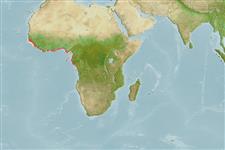
marino; acqua dolce; salmastro pelagic-neritic; distribuzione batimetrica 0 - 35 m (Ref. 86940). Tropical; 17°N - 7°S, 17°W - 14°E (Ref. 54448)
Africa: Atlantic coasts from northern parts of Senegal south to Baie de Saint-Bras in Angola (Ref. 188, 3509), also in lagoons and river estuaries (Ref. 188, 81270).
Lunghezza alla prima maturità / Dimensione / Peso / Età
Maturità: Lm 13.0, range 13 - 18 cm
Max length : 30.0 cm SL maschio/sesso non determinato; (Ref. 27000); common length : 16.0 cm SL maschio/sesso non determinato; (Ref. 188); peso massimo pubblicato: 144.00 g (Ref. 86940)
Breve descrizione
Chiavi di identificazione | Morfologia | Morfometria
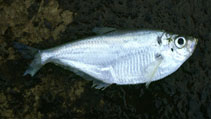
Spine dorsali (totale) : 0; Raggi dorsali molli (totale) : 14 - 17; Spine anali: 0; Raggi anali molli: 45 - 50; Vertebre: 42 - 43. Diagnosis: Body moderately deep, compressed, belly with a sharp and serrated keel of scutes from gill opening to anus, 25-27 pre-pelvic and 6-8 post-pelvic sharp scutes (Ref. 187, 188, 81270). Eye large, mouth pointing upwards, lower jaw projecting (Ref. 187, 188). Dorsal fin at or before midpoint of body; anal fin long, with more than 40 finrays, its origin below dorsal fin base; pelvic fins small (Ref. 187, 188). Swimbladder with two short tubes passing back in the muscles on either side of haemal spines (Ref. 188). Other clupeoid fishes in the area are more slender, have a much shorter anal fin and the lower jaw is not strongly projecting (Ref. 188).
Body shape (shape guide): fusiform / normal; Cross section: compressed.
Found in the marine environment, pelagic, along beaches and just off shore, down to about 25 m, also in lagoons and estuaries, penetrating into almost freshwater (Ref. 187, 188, 54448). A marine migrant (Ref. 117399). Rarely found below 35 m depth (Ref. 86940). It feeds on small planktonic animals, e.g. small fish and crustaceans; it doesn't seem to feed on plankton (Ref. 188, 3166, 47405).
Whitehead, P.J.P., 1985. FAO Species Catalogue. Vol. 7. Clupeoid fishes of the world (suborder Clupeoidei). An annotated and illustrated catalogue of the herrings, sardines, pilchards, sprats, shads, anchovies and wolf-herrings. FAO Fish. Synop. 125(7/1):1-303. Rome: FAO. (Ref. 188)
Stato della Lista Rossa IUCN (Ref. 130435: Version 2025-2 (Global))
Minaccia per l'uomo
Harmless
Usi umani
Pesca: commerciale
Strumenti
Rapporti speciali
Scarica XML
Fonti Internet
Stime basate su modelli
Temperatura preferita (Fonte Biblio.
123201): 25.9 - 28, mean 27.5 °C (based on 160 cells).
Indice di diversità filogenetica (Fonte Biblio.
82804): PD
50 = 0.5000 [Uniqueness, from 0.5 = low to 2.0 = high].
Bayesian length-weight: a=0.00676 (0.00558 - 0.00819), b=3.01 (2.96 - 3.06), in cm total length, based on LWR estimates for this species (Ref.
93245).
Livello trofico (Fonte Biblio.
69278): 3.6 ±0.2 se; based on diet studies.
Resilienza (Fonte Biblio.
120179): Alto, tempo minimo di raddoppiamento della popolazione meno di 15 mesi (K=0.8-1.3).
Prior r = 1.19, 95% CL = 0.79 - 1.79, Based on 3 data-limited stock assessments.
Vulnerabilità della pesca (Ref.
59153): Low vulnerability (21 of 100).
🛈
Vulnerabilità climatica (Ref.
125649): High to very high vulnerability (73 of 100).
🛈
Nutrienti (Ref.
124155): Calcium = 206 [110, 411] mg/100g; Iron = 2.01 [1.19, 3.28] mg/100g; Protein = 19.4 [18.0, 20.7] %; Omega3 = 0.397 [0.206, 0.739] g/100g; Selenium = 44.4 [20.6, 85.5] μg/100g; VitaminA = 20.2 [8.0, 49.5] μg/100g; Zinc = 1.52 [1.07, 2.15] mg/100g (wet weight);