>
Gobiiformes (Gobies) >
Gobiidae (Gobies) > Gobiinae
Etymology: Benthophilus: Greek, benthos = depth of the sea + Greek, phyle, that loves (Ref. 45335).
More on author: Sauvage.
Environnement : milieu / zone climatique / profondeur / gamme de distribution
Écologie
; eau douce; saumâtre démersal. Temperate; 4°C - 20°C (Ref. 2059); 56°N - 36°N, 22°E - 54°E
Europe: Black Sea, Sea of Azov and Caspian rivers and estuaries.
Taille / Poids / Âge
Maturité: Lm ? range ? - ? cm
Max length : 13.5 cm TL mâle / non sexé; (Ref. 2058); 11.0 cm TL (female)
Description synthétique
Clés d'identification | Morphologie | Morphométrie
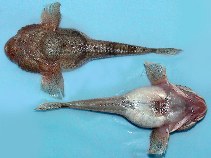
This species is distinguished from its congeners by the following characters: a tubercle between eyes; sparse granules on flanks, backward only to below D2 base, rare between upper lateral and dorsal rows of tubercles; head width 94-104 % HL; tubercles in dorsal row 27-30, ventral row 22-25, upper lateral row 10-16 (slightly smaller posteriorly), lower lateral row with few tiny tubercles or absent; chin barbel slightly compressed, thick, about equal in length with eye diameter; origin of D2 in front of anal origin; transverse rows of neuromasts on flank 19-23; no spot in front of D2; sides with dark blotches and irregular dots; a blotch around base of first dorsal usually reaching origin of D2 (Ref. 59043); head and body covered with spinulose bony platelets; rounded caudal fins and ventral suckers (Ref. 92840).
Body shape (shape guide): elongated.
Inhabits shallow coastal lagoons and lowland rivers in freshwater and brackish water with salinity below 12 ppt. Adults occur in muddy reaches of rivers; in brackish water, more than 3 m deep (Ref. 4696, 59043). This species spawns after first winter, May-June and females die shortly after spawning while with males, some weeks after. Feeds on mollusks, crustaceans, insect larvae and small fishes (Ref. 4696, 59043). Eggs are pear-shaped (Ref. 4696).
Miller, P.J., 1986. Gobiidae. p. 1019-1085. In P.J.P. Whitehead, M.-L. Bauchot, J.-C. Hureau, J. Nielsen and E. Tortonese (eds.) Fishes of the North-eastern Atlantic and the Mediterranean. Volume 3. UNESCO, Paris. (Ref. 4696)
Statut dans la liste rouge de l'IUCN (Ref. 130435: Version 2025-2 (Global))
Menace pour l'homme
Harmless
Utilisations par l'homme
Outils
Articles particuliers
Télécharger en XML
Sources Internet
Estimations basées sur des modèles
Indice de diversité phylogénétique (Réf.
82804): PD
50 = 0.5000 [Uniqueness, from 0.5 = low to 2.0 = high].
Bayesian length-weight: a=0.00741 (0.00347 - 0.01582), b=3.09 (2.91 - 3.27), in cm total length, based on LWR estimates for this (Sub)family-body shape (Ref.
93245).
Niveau trophique (Réf.
69278): 3.7 ±0.56 se; based on food items.
Résilience (Réf.
120179): Milieu, temps minimum de doublement de population : 1,4 à 4,4 années (Fec=700).
Vulnérabilité de la pêche (Ref.
59153): Low vulnerability (10 of 100).
🛈