>
Clupeiformes (Herrings) >
Pristigasteridae (Pristigasterids)
Etymology: Chirocentrodon: Greek, cheir = hand + Greek, kentron = sting + Greek, odous = teeth (Ref. 45335).
Eponymy: Dr Pieter Bleeker (1819–1878) was an ichthyologist and army surgeon commissioned (1841) by the Dutch East India Company. [...] (Ref. 128868), visit book page.
More on author: Poey.
Ambiente: milieu / zona climatica / distribuzione batimetrica / gamma di distribuzione
Ecologia
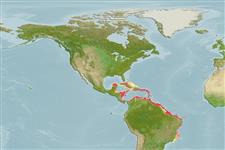
marino; salmastro pelagic-neritic; distribuzione batimetrica 20 - 60 m (Ref. 12225). Tropical; 24°N - 25°S, 90°W - 32°W (Ref. 188)
Western Atlantic: Cuba, Haiti, Jamaica, Puerto Rico, Trinidad; Panama and coasts of Venezuela, including off Orinoco mouth, Guyana, Suriname south to Ubatuba, near Santos, Brazil. Antilles and southern Caribbean from Yucatan to Santos, Brazil (Ref. 26938).
Lunghezza alla prima maturità / Dimensione / Peso / Età
Maturità: Lm 7.6 range ? - ? cm
Max length : 16.1 cm TL maschio/sesso non determinato; (Ref. 118626); common length : 9.0 cm TL maschio/sesso non determinato; (Ref. 5217); peso massimo pubblicato: 19.30 g (Ref. 118626)
Breve descrizione
Chiavi di identificazione | Morfologia | Morfometria
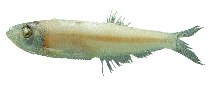
Spine dorsali (totale) : 0; Spine anali: 0; Raggi anali molli: 38 - 44. Belly with 16 or 17 (rarely 19) + 9 to 11, total 26 to 28 (rarely 30) scutes. Lower jaw not strongly projecting; strong conical teeth in both jaws, continued as large and small teeth along maxilla blade. Easily recognized by large, canine-like teeth in both jaws (Ref. 26938). Dorsal fin origin behind midpoint of body; anal fin moderately long, its origin below or in front of dorsal fin origin.
Body shape (shape guide): elongated; Cross section: compressed.
Occurs in coastal areas, but also in lagoons and off river mouths, perhaps entering water of lowered salinity (Ref. 12225). In Southwestern Atlantic preys on proportionally large clupeoid fishes and caridean shrimps. Fishes are distinctively folded in the stomachs of this herring, in about 90% of the cases with their heads and tails pointing head-wards the predator. This herring stands out as the only small-sized species among the predaceous fish-eating clupeiforms. The well developed canine-like teeth are likely related to a piscivorous diet and may play a role in the folding and orientation of fish during prey handling and swallowing (Ref. 51383). Spawns during the northern winter (Ref. 37032).
Ciclo vitale e comportamento di accoppiamento
Maturità | Riproduzione | Deposizione | Uova | Fecondità | Larve
Whitehead, P.J.P., 1985. FAO Species Catalogue. Vol. 7. Clupeoid fishes of the world (suborder Clupeoidei). An annotated and illustrated catalogue of the herrings, sardines, pilchards, sprats, shads, anchovies and wolf-herrings. FAO Fish. Synop. 125(7/1):1-303. Rome: FAO. (Ref. 188)
Stato della Lista Rossa IUCN (Ref. 130435: Version 2025-2 (Global))
Minaccia per l'uomo
Harmless
Usi umani
Pesca: pesca di sussistenza
Strumenti
Rapporti speciali
Scarica XML
Fonti Internet
Stime basate su modelli
Temperatura preferita (Fonte Biblio.
123201): 25.2 - 27.7, mean 27.1 °C (based on 45 cells).
Indice di diversità filogenetica (Fonte Biblio.
82804): PD
50 = 1.0000 [Uniqueness, from 0.5 = low to 2.0 = high].
Bayesian length-weight: a=0.00427 (0.00297 - 0.00613), b=3.02 (2.92 - 3.12), in cm total length, based on LWR estimates for this species (Ref.
93245).
Livello trofico (Fonte Biblio.
69278): 3.3 ±0.43 se; based on food items.
Resilienza (Fonte Biblio.
120179): Alto, tempo minimo di raddoppiamento della popolazione meno di 15 mesi (Preliminary K or Fecundity.).
Vulnerabilità della pesca (Ref.
59153): Low vulnerability (10 of 100).
🛈