>
Blenniiformes (Blennies) >
Chaenopsidae (Pike-, tube- and flagblennies)
Etymology: Emblemariopsis: Latin, emblema = insertion, inlaid work, raised ornament + Greek, opsis = appearance (Ref. 45335).
Ambiente: milieu / zona climática / intervalo de profundidade / gama de distribuição
Ecologia
marinhas associadas(os) a recifes; intervalo de profundidade 1 - 41 m (Ref. 125603). Tropical
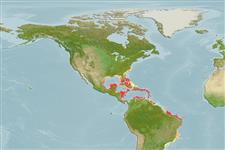
Western Central Atlantic: Bahamas.
Tamanho / Peso / Idade
Maturidade: Lm ? range ? - ? cm
Max length : 1.9 cm SL macho/indeterminado; (Ref. 5521); 1.7 cm SL (female)
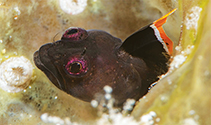
Raios dorsais moles (total) : 10 - 13; Espinhos anais: 2. Species distinguished by: underside of head dark or pale, no distinct dark spots; first dorsal-fin spine only slightly longer than third spine; first 2 dorsal-fin spines much longer than third and subsequent spines, with distal margin appearing angular as it drops abruptly to the shorter third spine; segmented dorsal-fin rays 10 to 13; total dorsal-fin elements 30 to 38; pectoral-fin rays 13; supraorbital cirrus on each eye arising from a single base, shorter than eye diameter; head smooth anteriorly, never spiny; tip of lower jaw not projecting beyond tip of upper jaw and without fleshy projection; one row of teeth on each palatine bone; no stripe or series of dark blotches on head and body; edge of opercle with series of small, round dark spots, or uniformly pigmented. Common amongst Chaenopsids: small elongate fishes; largest species about 12 cm SL, most under 5 cm SL. Head usually with cirri or fleshy flaps on anterior nostrils, eyes, and sometimes laterally on nape; gill membranes continuous with each other across posteroventral surface of head. Each jaw with canine-like or incisor-like teeth anteriorly; teeth usually also present on vomer and often on palatines (roof of mouth). Dorsal-fin spines flexible, usually outnumbering the segmented soft rays, spinous and segmented-rayed portions forming a single, continuous fin; 2 flexible spines in anal fin; pelvic fins inserted anterior to position of pectoral fins, with 1 spine not visible externally and only 2 or 3 segmented (soft) rays; all fin rays, including caudal-fin rays, unbranched (simple). Lateral line absent. Scales absent (Ref.52855).
Body shape (shape guide): elongated.
Photographed on live and dead coral substrate (Ref. 125603).
Ciclo de vida e comportamento de acasalamento
Maturidade | Reprodução | Desova | Ovos | Fecundidade | Larvas
Victor, B.C., 2020. Review of the glass blennies (Teleostei: Chaenopsidae: Emblemariopsis) with two new species from the Caribbean Sea. J. Ocean Sci. Found. 37:1-122. (Ref. 125603)
Categoria na Lista Vermelha da IUCN (Ref. 130435: Version 2025-2 (Global))
Ameaça para o homem
Harmless
Utilização humana
Ferramentas
Relatórios especiais
Descarregue XML
Fontes da internet
Estimativas baseadas em modelos
Temperatura preferida (Ref.
123201): 26.5 - 28, mean 27.5 °C (based on 160 cells).
Índice de diversidade filogenética (Ref.
82804): PD
50 = 0.5001 [Uniqueness, from 0.5 = low to 2.0 = high].
Bayesian length-weight: a=0.00525 (0.00224 - 0.01232), b=3.07 (2.86 - 3.28), in cm total length, based on LWR estimates for this (Sub)family-body shape (Ref.
93245).
Nível Trófico (Ref.
69278): 3.1 ±0.4 se; based on size and trophs of closest relatives
Vulnerabilidade da pesca (Ref.
59153): Low vulnerability (10 of 100).
🛈