>
Anguilliformes (Eels and morays) >
Ophichthidae (Snake eels) > Ophichthinae
Etymology: Quassiremus: Latin, quasso, quassus, = to shake + Lati, remus, -i = oars.
Umwelt: Milieu / Klimazone / Tiefenbereich / Verbreitungsgebiet
Ökologie
seewasser riff-verbunden; tiefenbereich ? - 12 m (Ref. 9710). Tropical
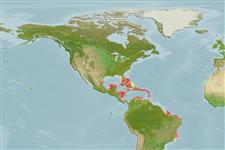
Western Atlantic: Bermuda, Bahamas, and the Lesser Antilles (Ref. 5521). Also Brazil. Southern Atlantic: Ascension Island (Ref. 26938).
Größe / Gewicht / Alter
Geschlechtsreife: Lm ? range ? - ? cm
Max length : 71.0 cm TL Männchen/unbestimmt; (Ref. 5521)
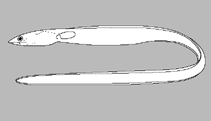
With a minute pectoral fin; row of dark spots along dorsal midline and alternating spots and blotches below lateral line (Ref. 26938).
Body shape (shape guide): eel-like.
Inhabits mixed patches of sand and turtle grass (Ref. 5521). Rare (Ref. 9710). Has been observed buried in the sand with only the head showing (Ref. 26938).
Lebenszyklus und Paarungsverhalten
Geschlechtsreife | Fortpflanzung | Ablaichen | Eier | Fruchtbarkeit | Larven
Böhlke, J.E. and C.C.G. Chaplin, 1993. Fishes of the Bahamas and adjacent tropical waters. 2nd edition. University of Texas Press, Austin. (Ref. 5521)
IUCN Rote Liste Status (Ref. 130435: Version 2025-2 (Global))
Bedrohung für Menschen
Harmless
Nutzung durch Menschen
Tools
Zusatzinformationen
Download XML
Internet Quellen
Schätzungen auf der Grundlage von Modellen
Bevorzugte Temperatur (Ref.
123201): 26 - 28.2, mean 27.5 °C (based on 619 cells).
Phylogenetischer Diversitätsindex (Ref.
82804): PD
50 = 0.5625 [Uniqueness, from 0.5 = low to 2.0 = high].
Bayesian length-weight: a=0.00093 (0.00041 - 0.00214), b=2.99 (2.79 - 3.19), in cm total length, based on LWR estimates for this (Sub)family-body shape (Ref.
93245).
Trophische Ebene (Ref.
69278): 3.8 ±0.6 se; based on size and trophs of closest relatives
Widerstandsfähigkeit (Ref.
120179): mittel, Verdopplung der Population dauert 1,4 - 4,4 Jahre. (Preliminary K or Fecundity.).
Anfälligkeit der Fischerei (Ref.
59153): Moderate to high vulnerability (48 of 100).
🛈