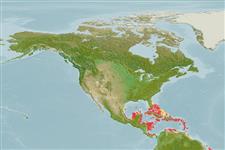
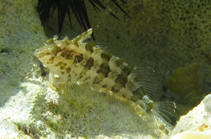
Ambiente: milieu / zona climática / intervalo de profundidade / gama de distribuição
Ecologia
marinhas associadas(os) a recifes; intervalo de profundidade 0 - 7 m (Ref. 9710). Tropical
Western Atlantic: Florida (USA), Bahamas, and Cuba south through the Antillean chain.
Tamanho / Peso / Idade
Maturidade: Lm ? range ? - ? cm
Max length : 7.6 cm TL macho/indeterminado; (Ref. 5521)
Espinhos dorsais (total) : 18; Raios dorsais moles (total) : 7 - 37; Espinhos anais: 2. Common amongst Labrisomids: small, often elongate fishes; largest species about 20 cm SL, most under 10 cm SL. Head usually with cirri or fleshy flaps on anterior nostrils, eyes, and laterally on nape; gill membranes continuous with each other across posteroventral surface of head. Each jaw with an outer row of relatively large, canine-like or incisor-like teeth, often with patches of smaller teeth behind; teeth usually also present on vomer and often on palatines (roof of mouth). Dorsal and anal fins long, frequently highest anteriorly; dorsal-fin spines often flexible, outnumbering segmented dorsal-fin soft rays; 2 usually flexible spines in anal fin; pelvic fins inserted anterior to pectoral-fin bases, with 1 spine not visible externally and only 2 or 3 segmented rays; all fin rays, including those of caudal, unbranched (simple). Cycloid (smooth to touch) scales present at least posteriorly on body. Body coloration: varying from drab to brilliant hues; usually with irregular vertical bands, spots, or marbled pattern. Species distinguished by: dorsal fin consisting of spines usually 18 and 7 to 37 segmented rays; pectoral-fin rays usually 14; pelvic-fin soft rays 3 (innermost ray may be reduced in length and folded over middle ray); scales in lateral-line series 40 to 69 (some scales in posterior portion of lateral line may lack sensory tubes, but are included in count); total nasal cirri (both sides) usually more than 7; two or more cirri on each side of nape just anterior to dorsal-fin origin; combination of conspicuous dark spot on anterior dorsal-fin spines and a dark ocellus extending from bases of posterior dorsal-fin spines onto dorsal contour of body not present; no small teeth behind large teeth in outer row; pectoral-fin base scales, when present, smaller than those on body; length of shortest pelvic-fin ray (third ray very difficult to see) contained fewer than 4 times in length of longest ray; maxillary bone sheathed; teeth absent on palatines (Ref.52855).
Body shape (shape guide): elongated.
Inhabits shallow sandy and rocky areas of coral reefs (Ref. 9710). Feed on copepods, amphipods, delicate algae and occasionally of eggs of Abudefduf (Ref. 5521).
Ciclo de vida e comportamento de acasalamento
Maturidade | Reprodução | Desova | Ovos | Fecundidade | Larvas
Böhlke, J.E. and C.C.G. Chaplin, 1993. Fishes of the Bahamas and adjacent tropical waters. 2nd edition. University of Texas Press, Austin. (Ref. 5521)
Categoria na Lista Vermelha da IUCN (Ref. 130435: Version 2025-2 (Global))
Ameaça para o homem
Harmless
Utilização humana
Ferramentas
Relatórios especiais
Descarregue XML
Fontes da internet
Estimativas baseadas em modelos
Temperatura preferida (Ref.
123201): 26.5 - 28.2, mean 27.5 °C (based on 510 cells).
Índice de diversidade filogenética (Ref.
82804): PD
50 = 0.5000 [Uniqueness, from 0.5 = low to 2.0 = high].
Bayesian length-weight: a=0.00525 (0.00218 - 0.01265), b=3.08 (2.86 - 3.30), in cm total length, based on LWR estimates for this (Sub)family-body shape (Ref.
93245).
Nível Trófico (Ref.
69278): 3.1 ±0.35 se; based on food items.
Vulnerabilidade da pesca (Ref.
59153): Low vulnerability (10 of 100).
🛈
Nutrientes (Ref.
124155): Calcium = 165 [80, 281] mg/100g; Iron = 0.798 [0.444, 1.387] mg/100g; Protein = 18.1 [17.0, 19.2] %; Omega3 = 0.0873 [, ] g/100g; Selenium = 18.3 [7.7, 40.8] μg/100g; VitaminA = 187 [54, 639] μg/100g; Zinc = 2.53 [1.64, 3.67] mg/100g (wet weight);