Umwelt: Milieu / Klimazone / Tiefenbereich / Verbreitungsgebiet
Ökologie
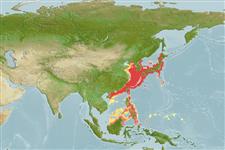
seewasser pelagic-neritic; ozeanodrom (Ref. 51243); tiefenbereich 0 - 400 m (Ref. 50550). Temperate; 8°C - 30°C (Ref. 56557); 49°N - 2°N, 105°E - 155°E (Ref. 54432)
Western Pacific: southern Sakhalin Islands, Sea of Japan and Pacific coasts of Japan, and south to almost Canton/Taiwan; rare records (seems to represent stray fishes) off the coasts of Luzon and Western Mindanao, Philippines and from Manado and Ujung Pandang, Sulawesi, Indonesia (Ref. 189).
Länge bei der ersten Reifung / Größe / Gewicht / Alter
Geschlechtsreife: Lm 10.5, range 10 - 11 cm
Max length : 18.0 cm TL Männchen/unbestimmt; (Ref. 56527); common length : 14.0 cm TL Männchen/unbestimmt; (Ref. 56527); max. veröff. Gewicht: 45.00 g (Ref. 56527); max. veröff. Alter: 4 Jahre (Ref. 56527)
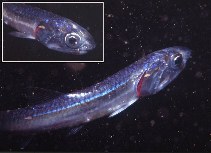
Rückenflossenstacheln (insgesamt) : 0; Rückenflossenweichstrahlen (insgesamt) : 12 - 14; Afterflossenstacheln: 0; Afterflossenweichstrahlen: 13 - 18. Differs very little from the European anchovy (see E. encrasicolus) and can be identified from that description. Of other anchovies found in the southern part of its distribution, only species of Encrasicholina and Stolephorus are of similar appearance, but all have small spine-like pre-pelvic scutes (usually 2 to 7 scutes). Thryssa have compressed bodies and a keel of scutes along belly.
Body shape (shape guide): elongated; Cross section: oval.
Occurs in large schools near the surface, mainly in coastal waters but as far out as over 1,000 km from the shore. Tends to move more northward and inshore in spring and summer. Juveniles associate with drifting seaweed (Ref. 12114, 12115). Feeds on copepods, but also on other small crustaceans, molluscan larvae, fish eggs and larvae and diatoms. Marketed fresh and salted, processed into fishmeal and oil (Ref. 12484).
Whitehead, P.J.P., G.J. Nelson and T. Wongratana, 1988. FAO Species Catalogue. Vol. 7. Clupeoid fishes of the world (Suborder Clupeoidei). An annotated and illustrated catalogue of the herrings, sardines, pilchards, sprats, shads, anchovies and wolf-herrings. FAO Fish. Synop. 125(7/2):305-579. Rome: FAO. (Ref. 189)
IUCN Rote Liste Status (Ref. 130435: Version 2025-2 (Global))
Bedrohung für Menschen
Reports of ciguatera poisoning (Ref. 4690)
Nutzung durch Menschen
Fischereien: hoch kommerziell; Aquakultur: kommerziell; Köder: usually
Tools
Zusatzinformationen
Download XML
Internet Quellen
Schätzungen auf der Grundlage von Modellen
Bevorzugte Temperatur (Ref.
123201): 8.1 - 23.3, mean 18.4 °C (based on 139 cells).
Phylogenetischer Diversitätsindex (Ref.
82804): PD
50 = 0.5020 [Uniqueness, from 0.5 = low to 2.0 = high].
Bayesian length-weight: a=0.00389 (0.00263 - 0.00576), b=3.10 (2.98 - 3.22), in cm total length, based on LWR estimates for this species & Genus-body shape (Ref.
93245).
Trophische Ebene (Ref.
69278): 3.1 ±0.1 se; based on diet studies.
Generation time: 1.1 (1.0 - 1.8) years. Estimated as median ln(3)/K based on 16
growth studies.
Widerstandsfähigkeit (Ref.
120179): hoch, Verdopplung der Population dauert weniger als 15 Monate. (K=1.05; tm=1-2; tmax=3).
Prior r = 0.90, 95% CL = 0.60 - 1.36, Based on 3 full stock assessments.
Anfälligkeit der Fischerei (Ref.
59153): Low vulnerability (23 of 100).
🛈
Nährstoffe (Ref.
124155): Calcium = 148 [56, 380] mg/100g; Iron = 0.698 [0.304, 1.783] mg/100g; Protein = 18.3 [16.8, 19.7] %; Omega3 = 1.57 [0.74, 3.39] g/100g; Selenium = 14.9 [5.6, 40.7] μg/100g; VitaminA = 7.51 [1.30, 42.67] μg/100g; Zinc = 0.939 [0.527, 1.630] mg/100g (wet weight);