>
Aulopiformes (Grinners) >
Scopelarchidae (Pearleyes)
Etymology: Scopelarchus: Greek, skopelos = a lantern fish + Greek, archos = anus (Ref. 45335).
Eponymy: ‘Michael Sars’ was the name of the Norwegian research vessel from which the holotypes were collected. The vessel was named after the Norwegian theologian and biologist Michael Sars (1805–1869). (Ref. 128868), visit book page.
Ambiente: milieu / zona climatica / distribuzione batimetrica / gamma di distribuzione
Ecologia
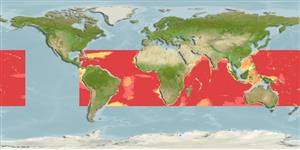
marino batipelagico; oceanodromo (Ref. 51243); distribuzione batimetrica 256 - 500 m (Ref. 58302). Deep-water; 30°N - 37°S, 85°W - 150°W
Atlantic, Indian and Pacific: in tropical and subtropical waters; widespread between 30°N to 0° in the eastern Atlantic, unknown from the Gulf of Guinea/Benguela Current area. Does not occur in the Mediterranean Sea and in the eastern Pacific east of 150°W.
Dimensione / Peso / Età
Maturità: Lm ? range ? - ? cm
Max length : 10.2 cm SL maschio/sesso non determinato; (Ref. 10755)
Breve descrizione
Chiavi di identificazione | Morfologia | Morfometria
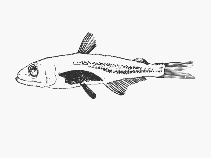
Spine dorsali (totale) : 0; Raggi dorsali molli (totale) : 7 - 9; Spine anali: 0; Raggi anali molli: 18 - 21. Medial face of pectorals with dense black pigment (Ref. 6601).
Body shape (shape guide): fusiform / normal.
Oceanic and mesopelagic (Ref. 6601, 58302). Most adults are taken in hauls to depths exceeding 500 m, none in hauls to depths less than 250 m. Larvae are taken year-round throughout its range, chiefly in hauls to depths less than 200 and apparently not in hauls restricted to the upper 100 m (Ref. 10755). Adults are presumed to prey on other midwater fishes. Synchronous hermaphrodites (Ref. 6691).
Ciclo vitale e comportamento di accoppiamento
Maturità | Riproduzione | Deposizione | Uova | Fecondità | Larve
Johnson, R.K., 1990. Scopelarchidae. p. 393-397. In J. C. Quero, J. C. Hureau, C. Karrer, A. Post and L. Saldanha (eds.) Check-list of the fishes of the eastern tropical Atlantic (CLOFETA). JNICT, Lisbon; SEI, Paris; and UNESCO, Paris. Vol. 1. (Ref. 10755)
Stato della Lista Rossa IUCN (Ref. 130435: Version 2025-2 (Global))
Minaccia per l'uomo
Harmless
Usi umani
Pesca: di nessun interesse
Strumenti
Rapporti speciali
Scarica XML
Fonti Internet
Stime basate su modelli
Temperatura preferita (Fonte Biblio.
123201): 8.7 - 9.4, mean 9 °C (based on 12 cells).
Indice di diversità filogenetica (Fonte Biblio.
82804): PD
50 = 0.5625 [Uniqueness, from 0.5 = low to 2.0 = high].
Bayesian length-weight: a=0.01122 (0.00514 - 0.02450), b=3.04 (2.87 - 3.21), in cm total length, based on all LWR estimates for this body shape (Ref.
93245).
Livello trofico (Fonte Biblio.
69278): 4.2 ±0.73 se; based on food items.
Vulnerabilità della pesca (Ref.
59153): Low vulnerability (10 of 100).
🛈