>
Clupeiformes (Herrings) >
Engraulidae (Anchovies) > Engraulinae
Etymology: Anchoviella: Italian ancioa = anchovy (Ref. 45335).
Eponymy: Professor Felipe Poey y Aloy (1799–1891) was a Cuban zoologist, naturalist and artist. [...] (Ref. 128868), visit book page.
More on author: Poey.
Umwelt: Milieu / Klimazone / Tiefenbereich / Verbreitungsgebiet
Ökologie
seewasser pelagic-neritic; tiefenbereich 0 - 50 m (Ref. 189). Tropical; 32°N - 10°N, 94°W - 60°W (Ref. 189)
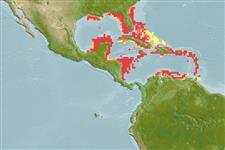
Western Central Atlantic: Beaufort, North Carolina south to Florida (USA); Antilles from Cuba to St. Lucia, also Trinidad, but not recorded at Blanquilla and Los Roques off Venezuela; also occurs off Panama.
Größe / Gewicht / Alter
Geschlechtsreife: Lm ? range ? - ? cm
Max length : 11.0 cm TL Männchen/unbestimmt; (Ref. 5217); common length : 9.0 cm TL Männchen/unbestimmt; (Ref. 5217)
Rückenflossenstacheln (insgesamt) : 0; Rückenflossenweichstrahlen (insgesamt) : 15 - 16; Afterflossenstacheln: 0; Afterflossenweichstrahlen: 10 - 18. Body slightly compressed; snout moderate, about 3/4 eye diameter; maxilla short with bluntly rounded tip, failing to reach pre-operculum by 1/2 pupil diameter; pseudobranch short, about 3/4 eye diameter; panamensis-type gill cover canals. Anal fin origin slightly behind base of last dorsal fin ray. A bright silver stripe along flank, about 3/4 or almost equal to eye, dark bordered above (Ref. 189). Body pale, few melanophores above, row of anal melanophores along anal-fin base. Eye orangish above, top of head with green and gold reflections (Ref. 7251).
Body shape (shape guide): elongated; Cross section: oval.
Occurs in coastal waters, apparently not entering brackish water. Rare in Florida shore seine collections, but 'in great numbers under a night light', perhaps because it may stay some distance from the shore in daytime.
Lebenszyklus und Paarungsverhalten
Geschlechtsreife | Fortpflanzung | Ablaichen | Eier | Fruchtbarkeit | Larven
Spawn in school (Ref. 205).
Whitehead, P.J.P., G.J. Nelson and T. Wongratana, 1988. FAO Species Catalogue. Vol. 7. Clupeoid fishes of the world (Suborder Clupeoidei). An annotated and illustrated catalogue of the herrings, sardines, pilchards, sprats, shads, anchovies and wolf-herrings. FAO Fish. Synop. 125(7/2):305-579. Rome: FAO. (Ref. 189)
IUCN Rote Liste Status (Ref. 130435: Version 2025-2 (Global))
Bedrohung für Menschen
Harmless
Nutzung durch Menschen
Fischereien: kleinfischerei; Köder: usually
Tools
Zusatzinformationen
Download XML
Internet Quellen
Schätzungen auf der Grundlage von Modellen
Bevorzugte Temperatur (Ref.
123201): 23.4 - 28, mean 26.4 °C (based on 226 cells).
Phylogenetischer Diversitätsindex (Ref.
82804): PD
50 = 0.5000 [Uniqueness, from 0.5 = low to 2.0 = high].
Bayesian length-weight: a=0.00525 (0.00247 - 0.01115), b=3.14 (2.97 - 3.31), in cm total length, based on LWR estimates for this (Sub)family-body shape (Ref.
93245).
Trophische Ebene (Ref.
69278): 3.2 ±0.4 se; based on size and trophs of closest relatives
Widerstandsfähigkeit (Ref.
120179): hoch, Verdopplung der Population dauert weniger als 15 Monate. (Preliminary K or Fecundity.).
Anfälligkeit der Fischerei (Ref.
59153): Low vulnerability (10 of 100).
🛈